If you have ever stood in a fitting room holding two bras — one labeled 28A and the other 28B — and genuinely could not tell the difference just by looking at them, you are absolutely not alone. These two sizes are incredibly close, and yet the distinction matters enormously for everyday comfort, support, and how your clothes sit on your body.
This guide is going to break it all down for you: what each size actually means, how the cup volumes compare, which one is likely right for your body, and what to do when neither feels quite right. We will also walk through a quick at-home fit test you can do in about three minutes, because honestly, the fitting room is not the only place you can figure this out.
Whether you are newly discovering you might be a 28 band (welcome to the club — it is smaller than most stores’ stock, and you deserve a proper fit), or you are debating between A and B cups, stick around. By the end of this, you will know exactly what to look for.
Why These Two Sizes Are So Confusing
Here is the thing most people do not know: bra sizing math is not as straightforward as the tag makes it look. For decades, the dominant fitting method — the outdated “+4 rule” — told women to measure their underbust and add four inches to get their band size. So someone with a 24-inch underbust would be told they were a 28 band. Fine enough. But then the cup size was calculated based on that inflated band number, which threw everything off.
The result? An enormous chunk of people were wearing band sizes that were too big and cup sizes that were too small. Someone who is actually a 28B might have spent years wearing a 32AA and wondering why nothing ever fit right.
Today, modern bra fitting has largely abandoned the +4 method. The goal now is to find your actual underbust measurement and use that as your band size. That means 28-band bras are made for people with a true 25–27 inch underbust, which is genuinely more common than most people assume, especially among petite and slim-build people.
So why are 28A and 28B still confusing even when you know your band size? Because the cup difference between A and B is just one inch of bust measurement, and that is a tiny margin. One bra style might fit you beautifully in a 28A; another brand’s 28B might be the better choice. Sister sizing (more on that below) adds another layer of complexity. If you want to remove the guesswork entirely, try our bra size calculator to confirm your starting size before you buy anything.
Measurement Breakdown: 28A vs 28B
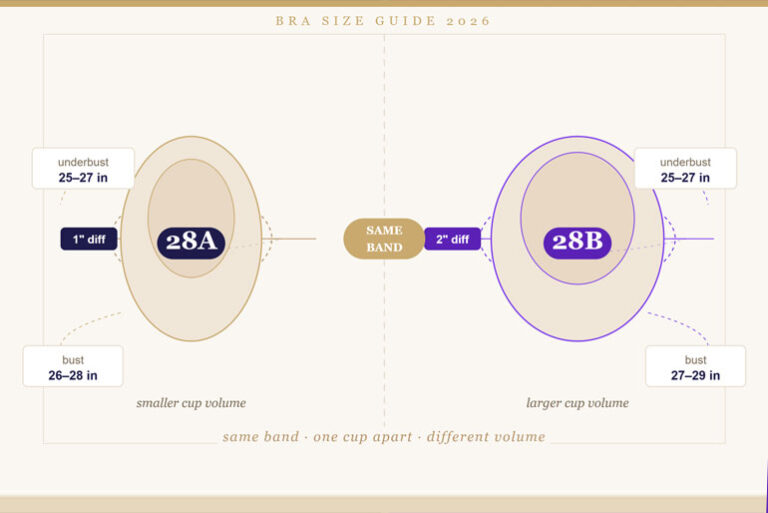
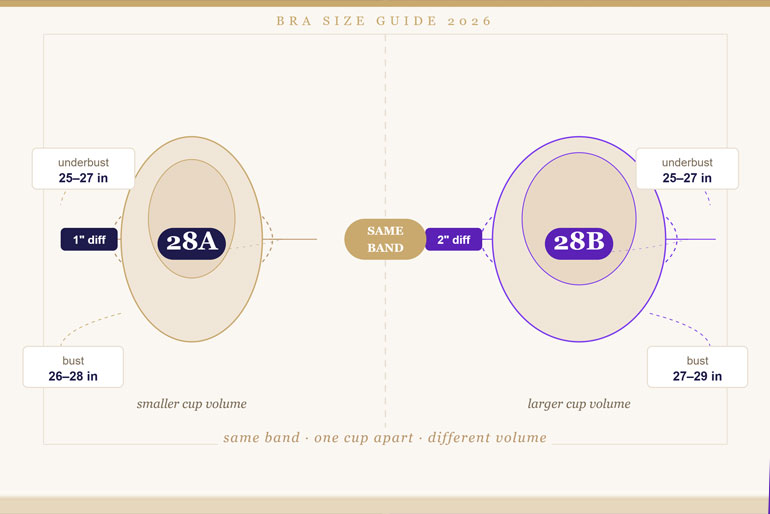
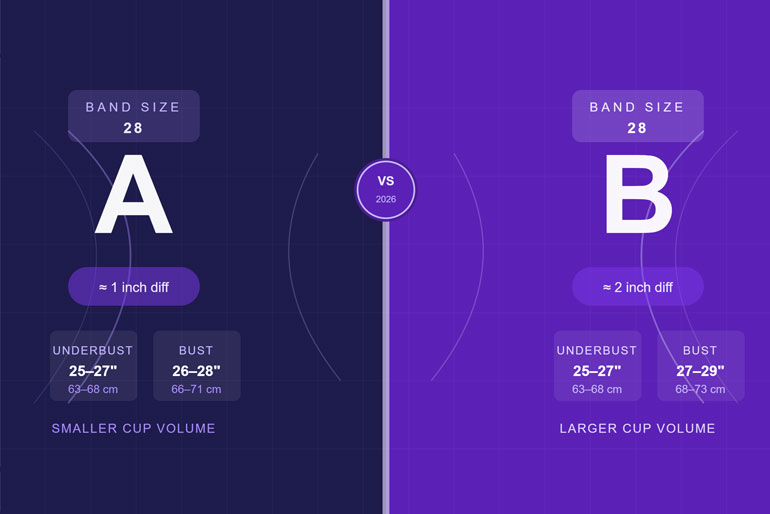
Both sizes share the same band — 28 — which means both are designed for the same underbust range. The only difference is the cup, which reflects the gap between your underbust and your fullest bust measurement.
| Measurement | 28A | 28B |
| Band Size (underbust) | 25–27 in / 63–68 cm | 25–27 in / 63–68 cm |
| Bust Measurement | 26–28 in / 66–71 cm | 27–29 in / 68–73 cm |
| Cup Difference | ≈ 1 inch / ~2.5 cm | ≈ 2 inches / ~5 cm |
| Cup Volume | Smaller than 28B | Larger than 28A |
Here is the part that trips people up: even though the cup letters are different, the actual volume difference is subtle. We are talking about roughly half an inch to one inch of extra projection. That said, for smaller ribcages, even that small difference can change how a bra sits, how centered the gore is, and how much lift you get.
If you want a deeper dive into how cup volumes actually compare across band sizes, our cup volume and projection guide covers it in detail with visuals.
Quick Comparison Table: 28A vs 28B
| Feature | 28A | 28B |
| Band Snugness | Firm, true to size | Firm, true to size |
| Support Level | Light-to-moderate | Moderate |
| Cup Volume | Smaller (≈ 1 inch bust/underbust diff) | Slightly larger (≈ 2 inch bust/underbust diff) |
| Best for Smaller Ribcage | Excellent fit | Good with proper style |
| Best for Wider Ribcage | May feel tight | May feel tight |
| Common Fit Problems | Gaping cups, slipping straps | Slight overflow, center gore gap |
Which Size Is Right For You?
The best way to decide between 28A and 28B is to combine your measurements with how bras have been fitting you recently. Here are two practical guides:
Choose 28A if…
- Your bust measurement is roughly 1 inch more than your underbust (e.g., 26 underbust, 27 bust)
- Cups in a 28B look visually too large or project too much for your frame
- You tend to find that B-cup bras have a gap at the top, especially in demi or balconette styles
- You wear XS or XXS in tops, and clothing tends to be too full in the chest
- Previous bras in 28B left red marks or dug in due to too much fabric
- You prefer unlined or bralette styles where a smaller cup looks more proportional
- Your breast tissue sits more spread out (shallow) rather than projecting forward
Choose 28B if…
- Your bust measurement is roughly 2 inches more than your underbust (e.g., 26 underbust, 28 bust)
- You tried a 28A and found the cups too flat — tissue was spilling out the sides or top
- The center gore of a 28A does not lie flat against your sternum
- You have noticed that A-cup bras in other band sizes (like 30A) feel slightly small
- Tops that are designed for a B cup tend to fit your chest area best
- You want more coverage and light shaping without going into a larger cup
- Your breast tissue has more forward projection (fuller at the front rather than spread wide)
3-Minute At-Home Fit Test
You do not need a professional fitter or a fancy boutique to figure out if a bra is working for you. Here is a simple seven-step test you can do at home right now:
- Measure your underbust. Use a soft tape measure and wrap it snugly (not tight) around your ribcage, just under your breast tissue. Round to the nearest whole inch. That number is your band size.
- Measure your bust. Keep the tape measure parallel to the floor and measure around the fullest part of your chest, usually across the nipples. Do not pull tight — let it rest naturally.
- Check the band. Put on the bra and fasten it on the loosest hook. Slide two fingers under the band at the center back. If more than two fingers fit easily, the band is too loose. If you cannot slide one finger in, it is too tight.
- Scoop and swoop. Lean forward, reach into each cup, and scoop all of your breast tissue into the cup. This is especially important for fuller shapes. If tissue is now overflowing the cup, you may need to size up.
- Check the center gore. Stand upright and press two fingers against the center front of the bra (the piece between the cups). It should lie flat against your sternum. If it floats away from your body, the cups are too small.
- Test the straps. Straps should sit comfortably on your shoulders without digging in or falling off. If you are relying on tight straps to hold the bra up, the band is likely too loose.
- Move around. Roll your shoulders forward, reach your arms overhead, and take a deep breath. The bra should stay in place, the cups should not shift, and you should be able to breathe comfortably without the band riding up.
Common Fit Mistakes to Avoid
- Tightening straps to compensate for band issues: Straps are for alignment, not lifting. If your bra feels unsupportive, the band is almost always the culprit — not the straps.
- Ignoring band ride-up: If your band creeps up your back throughout the day, the band is too loose. Try a smaller band or a different back closure style. For more on this, see our bra band rides up article.
- Assuming cup gaping means wrong cup: Gaping at the top of the cup often means the cup shape does not suit your breast shape, not that the cup is too big. A balconette might gap on someone who needs a plunge or full-coverage style.
- Trusting brand sizing without questioning it: A 28B in one brand can feel like a 28C in another. Always check a brand-specific size chart and read reviews about sizing before buying.
- Starting on the tightest hook: New bras should be worn on the loosest hook. As the elastic stretches over time, you move to tighter hooks. Starting tight means you have nowhere to go when the bra loosens.
- Ignoring the gore position: A floating center gore is one of the clearest signs that the cup size is too small. Many people tolerate this for years without realizing it is a fixable fit problem.
Sister Sizes to Try
Sister sizes share the same cup volume but in different band sizes. If a 28A fits your cup but the band feels slightly too snug, a 30AA might work. If a 28B fits your cup but the band feels loose, a 26C might be the answer.
| Your Size | Sister Size Down | Sister Size Up |
| 28A | 26B | 30AA |
| 28B | 26C | 30A |
Keep in mind that sister sizing works best as a starting point, not an exact science. You can explore the full sister size grid with our sister size chart, and use the sister size bra calculator to quickly find your options. If you want a personalized recommendation based on your measurements and fit symptoms, our AI smart fit calculator can help narrow it down even further.
Frequently Asked Questions
Is 28A smaller than 28B?
Yes. Both bras have the same 28-inch band, but the A cup is smaller in volume than the B cup. The difference is roughly one inch of bust measurement — so 28A has approximately a 1-inch difference between underbust and bust, while 28B has roughly a 2-inch difference.
Can I wear a 28B if I measure as a 28A?
It depends on your breast shape and the bra style. Some people with 28A measurements find that 28B bras in certain styles — especially those with shallow cups — fit better. If you are between sizes or right at the measurement boundary, trying both is worth it.
What is the sister size of 28A?
The sister sizes of 28A are 26B (smaller band, same cup volume) and 30AA (larger band, same cup volume). If 28A fits your cup but not your band, sister sizing is the first thing to try.
Why is my 28 band so hard to find in stores?
Most mainstream retailers stop at 30 or 32 as their smallest band. The 28 band is increasingly available through specialty lingerie retailers and online brands that cater to full-size ranges. It is not a niche size — it is just underserved by mainstream distribution.
Does 28A vs 28B make a difference in how clothes fit?
For most people, the difference is subtle enough that clothing fit will not change dramatically between the two. However, fitted tops, swimwear, and structured dresses may sit slightly differently. If your clothes consistently pull across the chest in a 28A, it is worth trying a 28B.
How do I know if my bra fits correctly?
The main signs of a good fit: band stays parallel to the floor at the back, cups contain all tissue without gaping or overflow, center gore lies flat, straps stay in place without digging, and you can breathe comfortably. Our bra fit problems guide covers every common issue and how to fix it.
Final Thoughts
The difference between 28A and 28B is real, but it is small enough that your best guide is your own body — not just the tape measure. Start with your measurements, use the fit test above as a sanity check, and pay attention to how the bra actually feels after a full day of wearing it.
If you are new to 28-band bras, welcome. A properly fitting 28-band bra is a revelation compared to the stretched-out 32s and 34s that most stores push. Your ribcage is not too small — the industry just never made enough options for it.
For more comparisons in this size range, check out our breast size comparison hub, and if you want to see how the cup sizes look visually across different frames, our cup size visuals guide is a great next step. You can also explore how to measure yourself correctly if you want to double-check your starting measurements.
Disclaimer
The sizing information in this article is intended as general guidance only. Bra sizing varies significantly between brands, styles, and countries. Individual fit can differ based on breast shape, tissue density, and personal preference. Always try bras on or review a brand’s specific size chart before purchasing. This article does not constitute professional fitting advice.