If you’ve ever stared at a bra tag wondering whether you need a 28B or a 28C, you’re not alone. These two sizes look almost identical on the label, and yet one fits perfectly while the other leaves you adjusting your straps every twenty minutes. I’ve been there.
The honest truth? The difference between 28B and 28C is smaller than most people think — and larger than others assume. In this guide, I’ll break down everything: band fit, cup volume, what sister sizes to try, and how to tell which one your body is actually asking for.
If you just want a quick answer, use our bra size calculator to find your exact size in under two minutes. But if you want to understand it, keep reading.
Why These Sizes Are So Confusing (And Who’s to Blame)
Let’s start with why bra sizing feels like decoding a foreign language. A lot of the confusion comes from an old-fashioned fitting method called the “+4 rule.” For decades, bra fitters were taught to measure the underbust and then add 4 inches to determine the band size. So if your underbust measured 24 inches, you’d be placed in a 28 band.
The logic made sense back when bra fabrics had almost no stretch. Modern bras are made with stretchy materials, so that extra buffer is completely unnecessary — and it throws off your cup size calculation entirely. A woman who measures 24 inches underneath and gets placed in a 28 band might think she’s a 28B when she’s actually closer to a 24E or 24F in a properly fitted modern bra.
This outdated method is still used in many department stores today, which is why millions of women are wearing the wrong size without even knowing it.
The second source of confusion is the sister sizing concept — the idea that certain sizes share the same cup volume despite having different letter designations. More on that in a moment. For now, the key takeaway is this: if your current bra never quite fits right, the +4 method is probably the reason. Start fresh with a proper measuring guide, and you might be surprised by what you find.
Measurement Breakdown: 28B vs 28C in Numbers
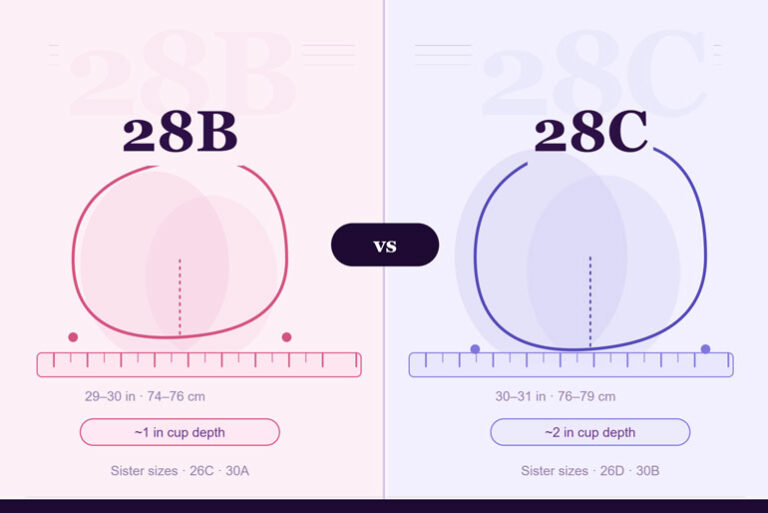
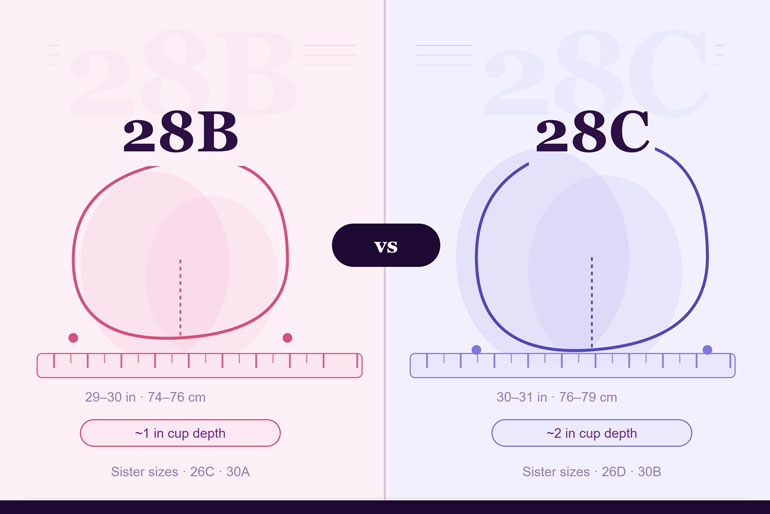
Both sizes share the same band — a 28-inch band designed to fit an underbust measurement of approximately 27–28 inches (68.5–71 cm). Where they diverge is in the cup.
28B Measurements
- Underbust: 27–28 inches / 68.5–71 cm
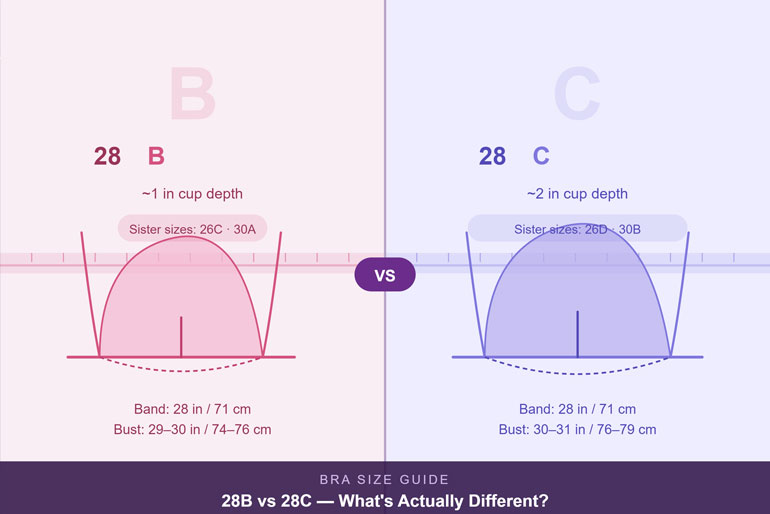
- Bust measurement: 29–30 inches / 73.5–76 cm
- Bust-to-underbust difference: approximately 1 inch / 2.5 cm
- Cup volume: relatively shallow, best suited for a smaller breast profile
28C Measurements
- Underbust: 27–28 inches / 68.5–71 cm
- Bust measurement: 30–31 inches / 76–78.5 cm
- Bust-to-underbust difference: approximately 2 inches / 5 cm
- Cup volume: slightly more projection and width than 28B
Here’s the part that trips most people up: the cup letter is relative to the band, not an absolute measurement of breast size. A 28C and a 30B actually hold the same cup volume — the breasts just happen to sit on different ribcage sizes. This is what bra fitters mean when they talk about “sister sizes.”
For a deeper dive into how cup volume works across band sizes, check out our cup volume and projection guide.
Quick Comparison Table: 28B vs 28C at a Glance
| Feature | 28B | 28C |
| Band Snugness | Firm — designed for a 28″ underbust | Firm — same 28″ band, identical snugness |
| Support Level | Moderate support for smaller cup volume | Slightly more support due to larger cup volume |
| Cup Volume | ~1″ difference between bust & underbust | ~2″ difference between bust & underbust |
| Comfort: Smaller Ribcage (<27″) | May feel too snug without extender | May feel too snug without extender |
| Comfort: Wider Ribcage (28–29″) | Great starting fit for 28″ band wearers | Great starting fit for 28″ band wearers |
| Common Fit Problems | Straps slipping, cup gaping if breast tissue is fuller | Underwire digging in if tissue is smaller, overfilling at top edge |
Which Size Is Right for You?
Instead of guessing, let’s use real fit symptoms to help you decide. Here’s how to think through it:
Choose 28B if…
- Your underbust measures 27–28 inches, and you prefer a snug, close-to-body band fit
- Your bust measures approximately 29–30 inches (a 1-inch difference from underbust)
- Cups in your current bra feel slightly too large or loose at the top
- You notice extra fabric or puckering at the top of the cup after scooping and swooping
- Underwires extend past your breast tissue toward your armpits
- You’ve tried a 30A and found the band too loose, but the cup felt right
- Delicate or petite frame, and most “petite” bras in 32A still feel too big in the cup
Choose 28C if…
- Your bust measures approximately 30–31 inches (a 2-inch difference from underbust)
- You’re currently in a 28B, and the cups feel tight, causing the fabric to pull or bulge
- Breast tissue is spilling over the top or sides of your current bra
- The center gore (the bit between the cups) floats away from your sternum
- You’ve tried a 30B, and it fits in the cup but feels loose around the band
- You notice quad-boob or wrinkling at the cup’s upper edge after swooping and filling the cup
- Your current bra gives you a pointy or distorted shape rather than a smooth, round silhouette
Still unsure? Our sister size bra calculator and AI smart fit calculator can give you a personalized recommendation based on your measurements and current fit symptoms.
The 3-Minute At-Home Bra Fit Test
Before you spend money on a new bra, run through this quick self-check. You’ll need a soft tape measure and about three minutes.
Step 1: Measure your underbust
Wrap the tape snugly around your ribcage, directly under your bust. You should be able to fit two fingers underneath. Round to the nearest whole number — that’s your band size.
Step 2: Measure your bust
Keep the tape parallel to the floor and measure around the fullest part of your bust, typically across the nipple line. Stay relaxed; don’t arch your back or pull the tape tight.
Step 3: Check your band
Put on your bra on the loosest hook. The band should sit parallel to the floor all the way around — not riding up at the back. You should be able to slide two fingers under the band, but no more.
Step 4: Scoop and swoop
Lean forward slightly, reach into each cup, and scoop all your breast tissue forward and up into the cup. This is called the “scoop and swoop” method. Any tissue left behind under your arms or at the sides belongs in the cup.
Step 5: Check the center gore
The center gore — the piece of fabric between your cups — should lie flat against your sternum. If it’s floating off your chest, your cups are too small, and you likely need to go up a cup size.
Step 6: Test the straps
Straps should contribute roughly 10–20% of the bra’s support. They should not be doing all the work. If you find yourself tightening straps to get a lift, your band is probably too loose. Slide two fingers under each strap — snug but not digging in is the goal.
Step 7: Move around
Jump gently, raise your arms above your head, and lean forward. A well-fitted bra stays in place through all of it. If your cups are gaping, if the band is riding up, or if tissue is escaping — you have your answer.
Common Fit Mistakes (And How to Fix Them)
These are the six mistakes I see most often when someone is hovering between 28B and 28C:
Mistake 1: Tightening the straps to compensate for a loose band.
Straps can only do so much. If your bra keeps slipping down, the problem is almost always the band, not the straps. Go down a band size rather than cranking your straps tighter — overtightened straps cut in and cause neck and shoulder pain.
Mistake 2: Assuming a gaping cup means the cup is too big.
Counterintuitive but true: a gaping cup at the top often means the cup is actually too small in volume, and the breast tissue is being pushed to the bottom of the cup. Try going up a cup size before giving up on the style.
Mistake 3: Blaming a riding band on the wrong hook.
A new bra should fit on the loosest hook. Starting on the tightest hook leaves no room for the bra to stretch over time. If it rides up even on the loosest hook, the band is too big.
Mistake 4: Ignoring brand-to-brand inconsistency.
A 28C from one brand can fit very differently from a 28C at another. Bra sizing is not standardized internationally. If a size doesn’t work in one brand, try the same size in a different cut or label before sizing up or down.
Mistake 5: Not scooping and swooping before checking fit.
Most women put a bra on and walk away. Without scooping all the breast tissue into the cup, you’re getting a false read on how the bra fits. Always scoop first, then assess.
Mistake 6: Ignoring the gore as a fit indicator.
A floating center gore is one of the most reliable signs that your cup is too small. Many people assume it’s just how their body is shaped — but a properly fitted bra’s gore should always touch the sternum. See our bra fit problems guide for a full breakdown of common fit issues.
Sister Sizes to Try for 28B and 28C
Sister sizes are bra sizes that share the same cup volume as your current size, just on a different band. They’re especially useful when your true size isn’t available in your preferred brand, or when you’re between sizes.
Here’s how the sister size system works for these two sizes:
| If you wear… | Try going down a band | Try going up a band |
| 28B | 26C (smaller band, same volume) | 30A (bigger band, same volume) |
| 28C | 26D (smaller band, same volume) | 30B (bigger band, same volume) |
The most important thing to remember: going to a sister size changes the band fit, not the cup volume. A 26C will hold the same breast volume as a 28B, but it’ll feel significantly tighter around your ribcage. A 30A will hold the same volume with a looser, more relaxed band.
Use our full sister size chart to explore more options across band sizes.
Frequently Asked Questions
Is there a big difference between 28B and 28C?
The difference is one cup size — which translates to roughly 1 inch (2.5 cm) more in bust circumference. In terms of visible size, the difference is subtle but noticeable, particularly in fit. Most women who go from a 28B to a 28C report that their bras suddenly stop gaping at the top and the center gore finally lays flat.
Which is bigger, 28B or 28C?
28C is the larger cup size. The band (28) is identical between both sizes. The C cup holds approximately 1 inch more in bust volume compared to the B cup on the same band.
Can I wear a 30A instead of a 28B?
Yes — 30A is a sister size to 28B, meaning they contain the same cup volume. The difference is that a 30A band is two inches larger and will feel noticeably looser around your ribcage. If you have a narrower ribcage and prefer a firmer band for better support, stick with the 28B. If you find 28 bands too tight, a 30A is worth trying.
What does a 28C look like compared to a 28B?
The difference is subtle when you look at the bra on a hanger — the cups are slightly wider and deeper in a 28C. On the body, the 28C will offer a bit more coverage and projection. For a visual side-by-side, visit our cup size visuals and breast size comparison hub.
My bra band keeps riding up — does that mean I should go to a 28C?
Not necessarily. A band riding up usually means the band is too loose — in which case, you’d want a smaller band, not a larger cup. But it can also happen if the cups are too small, causing the band to be pulled upward by the tension in the fabric. See our dedicated article on why your bra band rides up for a full diagnosis.
Are 28B and 28C considered small bra sizes?
In terms of the conventional sizing range sold in most high street stores, yes — both are considered small-to-petite sizes. However, in the bra fitting community, a 28-inch band is a narrow band size, and women wearing it often have fuller cup sizes than the mainstream market assumes. A 28C is not a “small” breast — it’s a breast that happens to sit on a narrow ribcage.
Final Thoughts: 28B vs 28C
At the end of the day, the “correct” size is whichever one fits — not whichever one your gut thinks sounds right. I know the instinct to stay with a B cup because it sounds more familiar. But bra sizing isn’t a grade or a value judgment. A 28C isn’t bigger in any meaningful sense — it’s just a better fit for a specific body.
If you’re wavering between the two, here’s my honest advice: buy one bra in each size from a brand with a good return policy, do the scoop-and-swoop, and check that center gore. Your body will tell you which one is right.
And if you’re still unsure, don’t guess — measure. Our bra size calculator takes under two minutes and gives you a starting size recommendation based on your actual measurements. From there, use the fit symptoms in this guide to fine-tune. You deserve a bra that works with your body, not against it.
For more size comparisons, check out our breast size comparison hub — we cover dozens of neighboring sizes to help you navigate the full range.
Disclaimer: Bra sizing varies by brand, country of manufacture, and individual body shape. The measurements and fit guidance in this article are general starting points, not medical advice. If you experience discomfort, pain, or persistent fit issues, consult a professional bra fitter in person. Sizing guides are based on commonly used methods in the UK and US markets and may differ from other regional standards.