
There’s a specific kind of dread that comes from opening a linen closet.
You pull the door open, a fitted sheet avalanches onto your foot, three mismatched pillow cases flutter to the floor, and you’re suddenly standing there at 10pm trying to make a bed, holding a sheet that looks like it belongs to a completely different set than the duvet cover in your hand.
That was me. For an embarrassingly long time.
My linen closet was basically a fabric landfill. Towels shoved in sideways. Extra blankets crammed on the top shelf with the confidence of someone who’s never had to get them back down. A random throw pillow that had no business being in there at all. I kept telling myself I’d sort it out “this weekend” — and then I didn’t, for about three years.
What actually changed things was a visit from my sister. She came to stay, I asked her to grab a spare towel, and she texted me from the hallway: “I opened the wrong door. Are you okay?”
That was the intervention I needed.
The Problem Isn’t Laziness — It’s No System
Here’s what I figured out after my sister’s very pointed text message: the reason my linen closet turned into chaos wasn’t because I was messy. It was because I never had a system for it. I’d fold things nicely and put them in, but without any logic to where things went, entropy always won.
Every time I grabbed a towel in a hurry, I’d disrupt whatever loose order existed and never quite put it back right. Every time I washed a set of sheets, I’d just stuff them in wherever there was space.
A linen closet without a system is just a fabric storage crisis waiting to happen.
So I started over. Completely emptied the thing out, took stock of what I actually had, donated a pile of ancient mismatched singles my family hadn’t used in years, and rebuilt from scratch.
Here’s exactly what I did — and what actually worked.
Step 1: Pull Everything Out (Yes, Everything)
I know it sounds obvious and a little overwhelming. But you cannot organise a linen closet by shuffling things around inside it. You have to fully empty it.
Lay everything on your bed or the floor. This does two things: it shows you exactly how much you have, and it gives you a moment of genuine clarity about how much of it you don’t actually need.
When I did this, I found:
- Four sets of sheets for a bed I no longer own (I moved house two years ago)
- Seven mismatched pillowcases with no matching sheets
- A duvet I genuinely forgot I had
- A tablecloth from a dinner party I hosted in 2021
Be honest with yourself during this step. If you haven’t used something in two years and it’s not sentimental, it can go. Donate it to a local charity or shelter — bedding is almost always needed.
Step 2: Sort Into Categories Before You Put Anything Back
Before a single thing goes back in the closet, sort everything into piles:
- Bed sheets (by bed size — single, double, king, etc.)
- Pillowcases
- Towels (bath, hand, face, beach — separate them)
- Blankets and throws
- Seasonal items (heavy winter duvets, spare electric blanket)
- Miscellaneous (table runners, curtains, anything random)
The key insight here is that most people sort by type only — all towels together, all sheets together. But sorting by use and frequency is what actually makes a closet functional.
Things you use every week should be at eye level and easy to grab. Things you pull out twice a year (the guest bedding, the winter blanket) should go up high or down low.
Step 3: The Shelf Assignment
This is the part where most people go wrong. They put things back where they fit rather than where they make sense.
Here’s the layout that worked for me:
Top shelf: Seasonal and occasional items. Spare duvets, heavy blankets, things that come out once or twice a year. Since this is harder to reach, I store them in vacuum storage bags (the ones you compress with a vacuum cleaner). Bought mine from IKEA — they’re brilliant and free up about half the space.
Eye-level shelves (middle): This is prime real estate. Everyday towels go here. Freshly washed sheets for the beds currently in use go here. Anything you reach for multiple times a week lives in the middle zone.
Lower shelves: Hand towels, face cloths, spare pillowcases, extra toilet paper rolls if you use the closet for that. Things you grab occasionally but not daily.
Door storage: I added an over-the-door organiser (the kind with clear pockets, from Amazon — the Whitmor one is great) and it completely changed the closet. Spare washcloths, small spare soaps, a lint roller, scissors for those rogue clothing tags — things that used to get lost in the bottom of drawers now have a home.
Step 4: The Sheet Set Trick That Changed My Life
This is legitimately the single best thing I learned from a home organisation YouTube rabbit hole at midnight.
Keep each sheet set together inside one of its own pillowcases.
Fold the fitted sheet, fold the flat sheet, fold them together, then slide the whole bundle inside a pillowcase and tuck the top in. Now you have one neat little package instead of three separate pieces that will absolutely get separated.
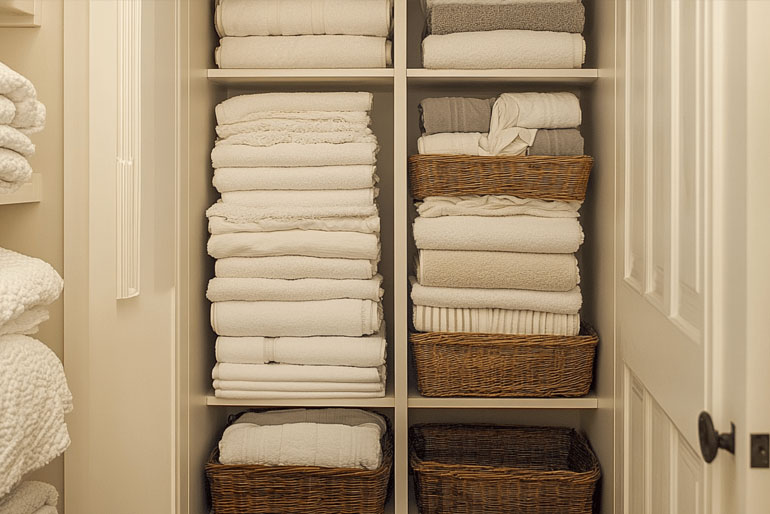
Stack these pillowcase bundles upright on the shelf (like files in a filing cabinet, not stacked in a pile), and you can see exactly what you have without pulling anything out.
This sounds small. It is not small. It is the difference between “which sheet goes with this?” at 10pm and just grabbing the package and walking away.
Step 5: Label or Colour Code (More Useful Than You’d Think)
I resisted this for a while because it felt overly fussy. But once I started using small adhesive labels on the shelf edges — nothing fancy, just a label maker or even handwritten card labels — it meant that everyone in the household could put things back in the right place.
My partner, who is lovely but had previously approached the linen closet with the energy of someone throwing things into a skip, now puts things back correctly. Because the label says where they go.
You can also use coloured towels or ribbon ties to separate sets if you share a house with multiple people — each person or bedroom gets a colour. Takes about ten minutes to set up and eliminates so many arguments about whose towels are whose.
Mistakes I Made (So You Don’t Have To)
Buying storage bins before I knew what I needed. I got excited, went to HomeSense, bought a bunch of pretty baskets, and then got home and realised they were slightly too wide for my shelves. Measure your shelves first. Write the measurements on your phone. Go to the shop. Come home with things that actually fit.
Keeping too much. I held onto sheets “just in case” for far too long. Just in case what? A surprise visit from eight people who all need their own bed? Be realistic about how many sets you need. For a single bed, two sets is usually enough — one on, one in the wash. For a guest bed, two sets. For your main bed, three if you want a buffer.
Ignoring the folding. I used to just fold things loosely and stack them. But loose folding takes up way more space than tight, consistent folding. The KonMari style of folding sheets (flat and rectangular, then folded into thirds, then thirds again) stacks beautifully and means you can fit significantly more on each shelf. There are good YouTube tutorials — I watched a couple from The Home Edit that were actually helpful and not too precious about it.
Not maintaining it. The first time I reorganised this closet, I felt extremely pleased with myself for about three weeks, and then gradually let it slide again. Now I do a quick tidy every time I do laundry — while I’m folding anyway, I take the extra 60 seconds to put things back in the right place. The big annual reset takes about 20 minutes now instead of a whole afternoon.
The Products That Actually Helped
I’m not sponsored by anyone here — these are just things I actually bought and used:
- IKEA SKUBB boxes — fabric boxes that fit IKEA wardrobes/closets perfectly. Great for grouping pillowcases and hand towels.
- Vacuum storage bags — game changer for bulky duvets and winter blankets. Any brand works.
- An over-the-door pocket organiser — the clear pocketed kind. Doubled my usable storage overnight.
- A label maker — I use a DYMO LabelManager 160. It’s basic, cheap, and has survived years of use.
- Shelf liners — optional, but they make the whole thing look cleaner and stop things sliding around.
One Last Thing
The before and after of my linen closet is not Instagram-worthy. I don’t have colour-coded towels rolled in perfect spirals. My labels aren’t engraved acrylic. It looks like a normal, functional closet where things are easy to find and easy to put back.
That’s the actual goal. Not perfection — just a system that works when you’re tired, when you’re in a hurry, and when someone else needs to find a towel at 10pm without texting you in despair.
Get the system right, and the tidiness mostly takes care of itself. That’s been true for me for about two years now, and honestly, the closet has become one of my favourite things about my home — which is a sentence I never thought I’d write.
Start with the full empty-out. The rest follows.