I still remember standing in a fitting room years ago, holding a 28C in one hand and a 28D in the other, absolutely convinced one of them was a “mistake” on the label. They looked so similar. Same band number. Just one letter apart. How different could they really be?
Turns out, pretty different — just not in the way most of us expect. If you’ve been going back and forth between 28C and 28D, you’re not overthinking it. This is one of the most commonly confused size pairs out there, and there’s a real reason for that. Let’s break it down properly, so you can stop guessing and start wearing a bra that actually fits.
Why These Sizes Are Confusing
Here’s the thing that trips almost everyone up: 28C and 28D have the exact same band size. The “28” doesn’t change. What changes is cup volume — how much space your bust needs relative to that band. So when people say “I don’t know if I’m a C or a D,” they’re not confused about their ribcage. They’re confused about volume, and that confusion has some very specific roots.
The biggest culprit is the old “add 4 inches” fitting method that department store associates used for decades (and some still do). That method took your underbust measurement, added four inches, rounded to the nearest even number, and called that your band size. It worked reasonably well when bras were designed with looser, stretchier bands — but modern bras are built with firm, supportive bands meant to sit snug and do most of the support work themselves. The result? Millions of women were sized into bands that were too big and cups that were, ironically, often too small to compensate. If you were fitted this way at any point, there’s a good chance your “true” size is completely different from what’s on your tag.
Then there’s sister sizing, which is a genuinely useful concept once you understand it, but confusing if nobody ever explains it. Sister sizes are different band-and-cup combinations that hold roughly the same cup volume. Going up a band size and down a cup letter (or vice versa) keeps the volume basically constant while changing how snug the band feels. This is why a 30C and a 28D can fit almost identically in the cup — same volume, different band. It’s also why so many people land between 28C and 28D specifically: they’re not actually choosing between two totally different cup volumes, they’re often choosing based on band comfort while the cup volume conversation happens somewhere else entirely.
If you’re not sure where you land on the scale to begin with, it’s worth running your numbers through a proper bra size calculator before reading any further — it’ll save you a lot of the back-and-forth this article is about to walk you through.
Measurement Breakdown
Let’s get into actual numbers, because vague descriptions don’t help anyone.
Band size (underbust measurement) — this is identical for both sizes, since they share the same “28” band:
- Snug underbust measurement: roughly 23–24.5 inches (58–62 cm)
That’s the firm, breath-out measurement taken directly under the bust, where the band sits.
Bust measurement (fullest point) — this is where the two sizes diverge:
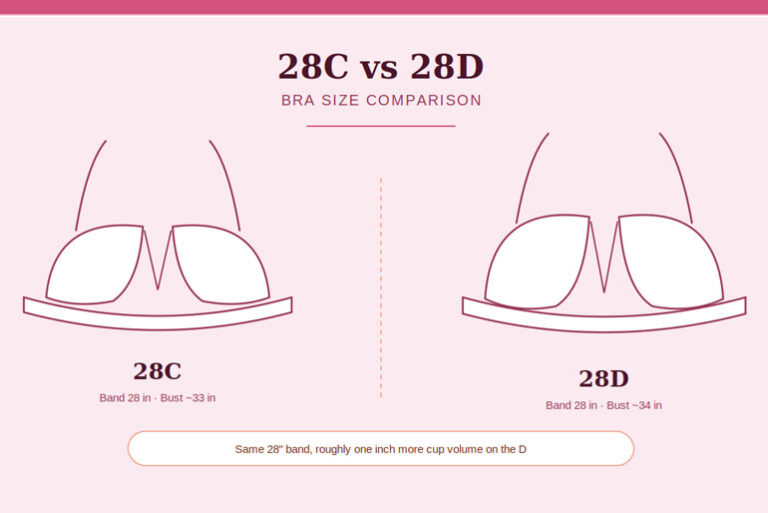
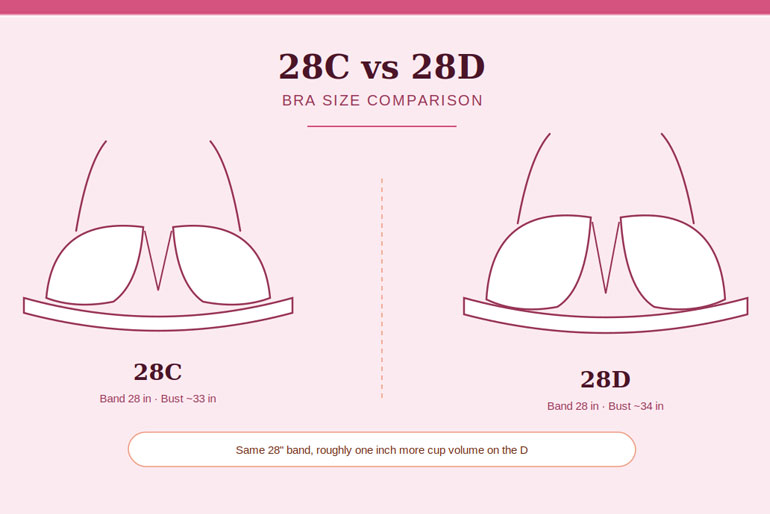
- 28C: approximately 33–34 inches (84–86 cm)
- 28D: approximately 34–35 inches (86–89 cm)
So the actual difference between a 28C and a 28D usually comes down to about one inch (2–3 cm) of bust circumference. That one inch translates into a noticeably larger cup, because cup volume increases exponentially, not evenly, as you move up the alphabet — the same one-inch jump means less added volume at an A-to-B jump than it does at a C-to-D jump.
This is also why cup volume isn’t a fixed size the way people assume. A “D cup” doesn’t mean the same physical volume across every band. A 28D holds noticeably less volume than a 34D, even though they share a letter, because the cup is sized proportionally to the band. This is the entire logic behind sister sizing, and it’s worth internalizing: the letter alone tells you nothing without the band number next to it.
If you want to go deeper on how cup volume and shape interact — including why two people with the “same” cup size can look completely different depending on projection and root size — the cup volume and projection guide breaks that down with visuals, which honestly helps more than numbers alone.
Quick Comparison Table
| Factor | 28C | 28D |
| Band snugness | Same snug 28 band; should feel firm on the loosest hook | Same snug 28 band; should feel firm on the loosest hook |
| Support level | Good support for moderate fullness; less structure needed | Slightly more structure and wire coverage needed for the extra volume |
| Cup volume | Moderate volume, roughly one size below 28D | About one cup size more volume than 28C |
| Comfort for smaller ribcage | Very comfortable; less cup fabric to manage | Can feel like “a lot of bra” on a very narrow frame if the style isn’t chosen carefully |
| Comfort for wider ribcage | May feel like cups run slightly shallow if bust is fuller than average | Tends to feel more balanced and proportional |
| Common fit problems | Cup gapping at the top if you’re actually closer to a D | Quadboob or spillage at the sides if you’re actually closer to a C |
Which Size Is Right For You?
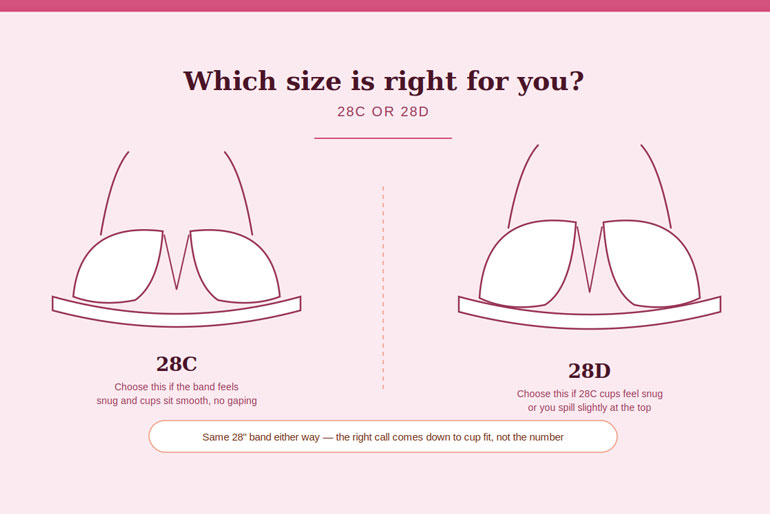
Choose 28C if…
- Your snug underbust measurement lands around 23–24.5 inches, and your bust is closer to 33–34 inches
- The cups of a 28D leave visible gaping at the top, especially in unlined or lightly lined styles
- You feel like a 28D “swallows” your bust, and the wires don’t sit flush against your ribcage
- You’ve never felt the need for extra side coverage or a higher center panel
- Your straps stay in place easily without digging in, even at a moderate tightness
- T-shirt bras and lightly padded styles in 28C already look smooth under clothing
- You don’t notice spillage at the top or sides when wearing 28C
Choose 28D if…
- Your bust measurement is closer to 34–35 inches, with the same 23–24.5 inch underbust
- You get visible spillage, “quadboob,” or side bulge in 28C cups, especially in balconette or plunge styles
- The band on your 28C rides up in the back within an hour of wearing it, suggesting the cups aren’t holding enough volume to keep everything anchored
- You’ve noticed red marks or pressure at the top of the cup where breast tissue is being compressed rather than contained
- Underwire that digs into the outer breast or armpit in a 28C, rather than sitting flat against the ribcage
- You feel like you’re constantly adjusting or “resettling” your bust throughout the day in 28C
- Fuller-coverage or plunge styles feel noticeably more comfortable and secure than shallower cup shapes
3-Minute At-Home Fit Test
You genuinely don’t need a fitting room appointment to figure this out. Grab a soft measuring tape and try this:
- Measure your underbust. Wrap the tape directly under your bust, snug but not squeezing, and note the number in inches.
- Measure your bust. Wrap the tape around the fullest part of your bust, keeping it level and not too tight. Note that number too.
- Check the band. Put on your current bra and check the loosest hook. The band should sit level, parallel to the floor, and feel firm — if it’s riding up in the back or you’re on the tightest hook already, it’s likely too big.
- Do the scoop and swoop. Lean forward, let everything settle into the cups, then scoop your breast tissue in from the sides and center as you stand up. If the cups still gap or overflow after this, that’s your answer about cup size, not band size.
- Check the center gore. The center panel (the piece between the cups) should lie flat against your sternum. If it’s floating off your chest, the cups are too small; if it digs in painfully, that can point to too-small cups or the wrong wire shape for your shape.
- Test the straps. Straps shouldn’t be doing the heavy lifting. If loosening them completely still leaves your bust supported, your band and cup are doing their job. If loosening them causes everything to drop, the band or cup size needs adjusting.
- Move around. Walk, raise your arms, sit down. A correctly fitted 28C or 28D should stay put through all of it, without the band creeping up or the cups shifting out of place.
For a more detailed version of this process with photos for each step, the how to measure guide is worth bookmarking.
Common Fit Mistakes
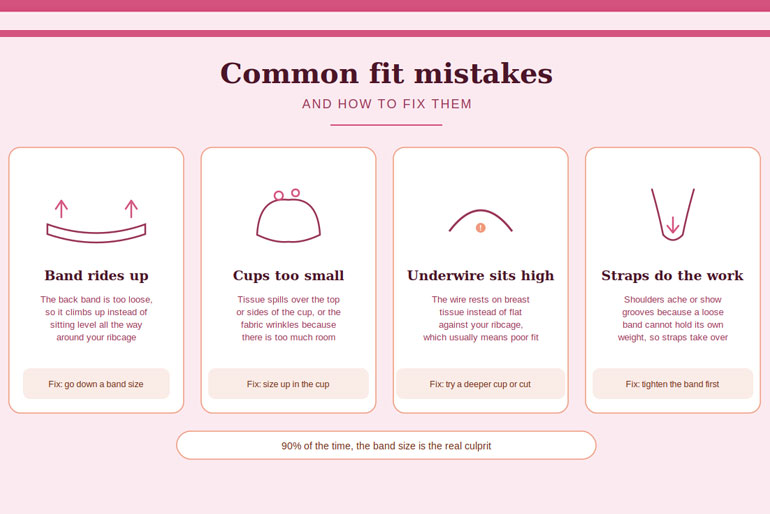
Even people who’ve been bra shopping for years fall into these:
- Tightening the straps to fix a support problem. If the band or cup isn’t right, straps can’t compensate — they’ll just leave marks on your shoulders instead.
- Ignoring a band that rides up in back. This almost always means the band is too big, not that you need “more support” from elsewhere.
- Assuming any gaping means the cup is too big. Sometimes gaping is actually a shape issue (like projection or asymmetry), not a volume issue — worth checking the bra fit problems guide before you size down.
- Trusting sizing to be identical across brands. A 28C in one brand can fit like a 28D in another. Always fit to how the bra sits on your body, not the label.
- Starting on the wrong hook. New bras should start on the loosest hook, so there’s room to tighten the band as the elastic naturally stretches out over months of wear.
- Ignoring the center gore entirely. A gore that floats off your sternum is one of the clearest, most reliable cup-size signals there is, and it’s the one most people forget to check.
If a band that constantly creeps up your back sounds familiar, the bra band rides up guide walks through exactly why that happens and how to fix it, beyond “just get a smaller band.”
Sister Sizes to Try
If neither 28C nor 28D feels quite right, sister sizing can point you toward a better-fitting band without changing the cup volume you already know works.
Sister sizes for 28C (same cup volume, different band feel):
- 30B — slightly looser band, same volume
- 32A — even looser band, same volume
Sister sizes for 28D (same cup volume, different band feel):
- 30C — slightly looser band, same volume
- 32B — even looser band, same volume
If your band feels snug but your cups are consistently right in 28C or 28D, stick with the 28 band and don’t touch the cup letter. If the band is the uncomfortable part, try the sister size before assuming you need a different cup letter altogether. For a full visual reference across every band and cup pairing, the sister size chart and sister size bra calculator are both worth running your numbers through.
And if you’d rather skip the manual math altogether, our AI-powered smart fit calculator can factor in your measurements, current bra fit complaints, and preferred coverage style to suggest a starting point — it’s not a replacement for trying bras on, but it’s a genuinely useful shortcut.
FAQ
Is 28D bigger than 28C?
Yes, in terms of cup volume. The band size is identical (28), but the D cup holds more volume than the C cup on that same band — roughly one cup size of difference, which usually corresponds to about an inch of bust measurement.
Can I wear a 28C if I measure closer to a 28D?
You can, but you’ll likely notice spillage, gaping wires digging into the sides of your bust, or a band that rides up because the cups aren’t containing enough volume to keep things anchored. It’s more comfortable to size up the cup than to force a smaller one.
Why do 28C and 28D look so similar on the shelf?
Because the band — which makes up most of a bra’s visible structure — is exactly the same. The difference lives almost entirely in the cup, which can be hard to judge just by looking at a bra on a hanger.
Should I go up a band size instead of up a cup letter?
It depends on what’s uncomfortable. If the band itself feels too tight or leaves marks, sizing up the band (and adjusting the cup via sister sizing) may solve it without changing cup volume. If the band feels fine but the cups don’t contain everything, stay in the 28 band and go up a cup letter.
How do I know if I’ve been wearing the wrong size for years?
Classic signs include straps digging in, a band that rides up constantly, underwire that pokes at the sides or center, visible spillage or gaping, and a bra that feels “off” no matter how you adjust it. If more than one of those sounds familiar, it’s worth remeasuring from scratch.
Does cup size mean the same thing in every band size?
No — this is the single most misunderstood part of bra sizing. A cup letter only makes sense in the context of its band number. A 28D and a 34D hold very different volumes, even though they share a letter.
Final Thoughts
The gap between 28C and 28D isn’t really about which size is “correct” in some universal sense — it’s about which one actually contains and supports your bust without gapping, spilling, or forcing your band or straps to overcompensate. Most people can tell within a day of wearing each size which one behaves better through a normal routine of sitting, moving, and reaching. Trust what your body is telling you over what a label says it “should” be, and don’t be surprised if you land on a sister size in a completely different band once you start paying attention. If you’re still stuck, run your numbers through the bra size calculator or browse the breast size comparison hub for more pairings like this one — chances are, you’re not the only one who’s been stuck between these exact two sizes.
Disclaimer
This article is intended for general educational and informational purposes only and is not a substitute for a professional fitting. Bra sizing varies by brand, style, and body shape, so measurements and size suggestions here should be treated as a starting point rather than an exact guarantee of fit. If you experience persistent pain, skin irritation, or discomfort from your bra, consider consulting a professional fitter or a healthcare provider.