
I still remember the moment I realized something was very wrong. I was getting ready for a dinner out, reached for my favorite underwire bra — the one I’d worn for years — and it just… didn’t fit. Not even close. The band was digging in, the cups were overflowing, and I genuinely thought the thing had shrunk in the wash.
It hadn’t. I had changed.
I’d gained around 15 pounds over the previous six months (thank you, working from home and a suspicious love affair with sourdough bread), and somehow, in all the ways my body had shifted, my bra size was the last thing I’d thought to check. I had been uncomfortable for weeks and just kept blaming my bras for being “old.”
This is more common than you’d think. Whether you’re losing weight intentionally, gaining through pregnancy, building muscle, going through hormonal changes, or just getting older, your bra size is not a fixed number. It moves. A lot. And most of us were never taught how to track it.
Why Your Bra Size Is More Complicated Than a Number and a Letter
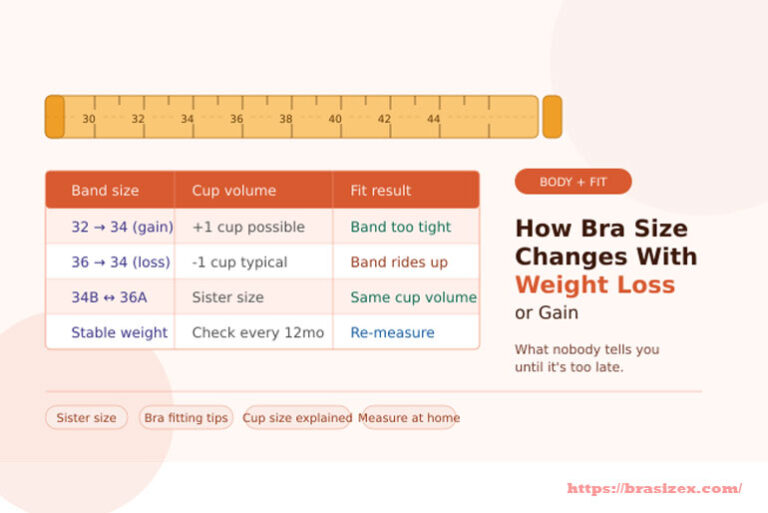
Here’s the thing that trips most people up: a bra size isn’t one measurement. It’s actually two — the band size (that number, like 34 or 38) and the cup size (the letter, like B or D). And both of them change when your body changes. But they don’t always change at the same rate or even in the same direction.
The band size is tied to your rib cage measurement — the circumference directly under your bust. This is mostly structural. Your ribs don’t shrink dramatically (unless you’re losing significant weight), but the fatty tissue and muscle around your torso absolutely do change with weight fluctuation. Lose 20 pounds, and that band could drop by a full size or two. Gain weight and the opposite happens — the band gets tighter, and suddenly a 36 feels like a 32.
The cup size is relative. This is where it gets confusing. A “D cup” in a 34 band is physically smaller than a “D cup” in a 38 band. Cup size only means something when paired with the band size. So if your band size changes, your cup size label might change even if the actual volume of your breast tissue stays the same. This concept — called sister sizing — is something most women don’t learn until they’ve gone through years of wearing the wrong size.
What Actually Happens to Breast Tissue When You Lose or Gain Weight
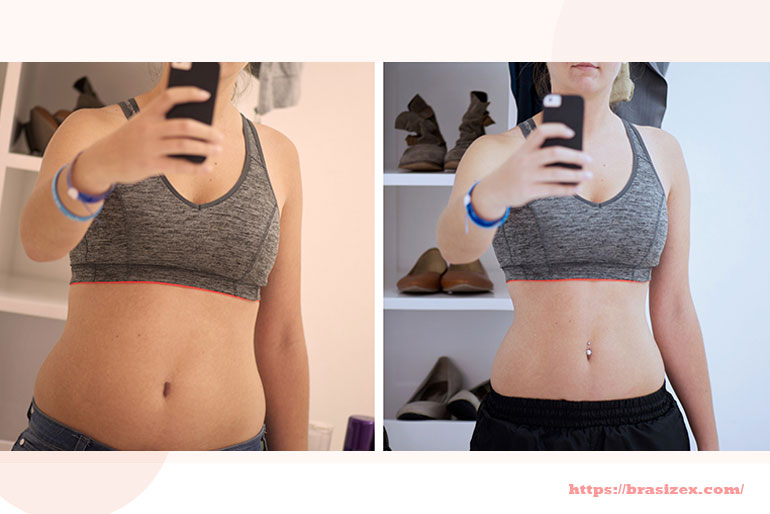
Breasts are largely composed of fatty tissue (along with glandular tissue, ligaments, and skin). Because fat is distributed throughout the body during weight gain or loss, the chest is almost always affected.
For most people, breast size and weight track together. Gain weight, gain cup volume. Lose weight, lose some volume. But how much changes varies wildly from person to person — it’s genetic. Some people lose weight and barely notice a change in their chest. Others drop a full cup size for every ten pounds lost.
There’s also the band situation. As you lose fat around your torso, the band gets looser — which actually makes your bra feel like it fits worse even if your breasts haven’t changed much. You’ll notice the band riding up in the back, the straps falling off your shoulders, and general instability. That’s not about cup size. That’s about the band no longer anchoring properly.
When you gain weight, the reverse: the band gets tight, creates back bulge, and may feel restrictive. Meanwhile the cups might not overflow right away — especially if the gain is more distributed throughout the body — leading to an awkward phase where the band is too tight but the cups feel fine.
The Mistake I Made (And You Probably Have Too)
After my weight gain, I did what most people do: I kept wearing the same bras and just blamed the discomfort on “bad bras” or “getting older.” I even bought two new bras in what I thought was my size, based on the size I’d worn for five years.
They were wrong too. Because I’d never been professionally measured. I’d been guessing my size since college based on a bra that had fit well in my twenties, and I’d just… assumed I was still that size.
When I finally went into a lingerie shop (I used a local boutique, but places like Nordstrom, ThirdLove, or even Soma offer fittings), the woman who helped me took one look at what I was wearing and said, “You’re in the wrong bra.” Not rudely — but matter-of-factly. Turns out I had been wearing a too-small band with a too-large cup for years. My actual size was different from what I’d been buying, and the difference was genuinely night and day in terms of comfort and support.
How to Figure Out Your New Size After Weight Changes
You don’t need a professional fitting every time (though it’s worth doing at least once in your life). Here’s how to measure yourself at home with a soft measuring tape:
Step 1: Measure your band size
Wrap the tape measure snugly (but not painfully tight) around your torso, directly under your bust — right where the band of a bra would sit. The tape should be parallel to the floor. Round to the nearest whole number. If it’s an even number, that’s your band size. If it’s odd, try both that size and the next size up to see which feels right.
Step 2: Measure your bust
Now measure around the fullest part of your chest — across the nipples, keeping the tape parallel. Don’t pull it tight; let it sit naturally. Note this number.
Step 3: Calculate cup size
Subtract your band measurement from your bust measurement. The difference tells you your cup size:
- 1 inch = A
- 2 inches = B
- 3 inches = C
- 4 inches = D
- 5 inches = DD/E
- 6 inches = DDD/F
So if your band measures 34 and your bust measures 38, the difference is 4 — making you a 34D.
Step 4: Do a real-world fit check
Put the bra on the loosest hook (so you have room to tighten as the elastic stretches over time). The band should be snug, but you should be able to slip two fingers underneath. The underwire (if there is one) should lie flat against your ribcage — not poking into breast tissue. The center gore (the middle piece between the cups) should lie flat against your sternum. The cups should contain your breast tissue fully, with no spillage or gaps.
If any of these things are off, try adjusting the size up or down using the sister sizing principle before buying something new.
Sister Sizing: Your Secret Weapon
Here’s the trick that changes everything: if your cup fits but the band is too tight, go up one band size and down one cup letter. If the band fits but the cups are too small, go down one band size and up one cup letter.
Example: You’re in a 36C, and the band feels tight, but cups fit fine → try a 38B. Same cup volume, looser band.
Or: You’re in a 34B, and the cups feel small, but the band is fine → try a 32C. Same band tightness, more cup room.
This comes in so useful during the in-between stages of weight change — when you’re not quite the old size but not fully settled into a new one either.
When to Re-Measure (Specific Triggers)
Don’t wait until things feel dramatically wrong. Here’s when it’s worth checking:
- After losing or gaining more than 10–15 pounds — noticeable changes in band size are common at this threshold.
- After pregnancy and postpartum — breast size fluctuates massively during and after pregnancy, especially if you’re breastfeeding. Many women end up in a completely different size category postpartum.
- During perimenopause or menopause — hormonal changes redistribute fat and can change breast tissue density.
- After significant muscle gain — building back and chest muscle can change how a bra band fits even without fat changes.
- Every 12–18 months as a baseline — even without major weight change, elastic stretches and bodies drift.
A Note on Cheap Bras During Transition Phases
If you’re actively losing or gaining weight and you’re not at a stable size yet, this is genuinely not the time to invest in expensive bras. I learned this when I bought three gorgeous bras right in the middle of a weight loss journey — and they were already the wrong size two months later.
During transition, go for affordable options. Target’s Auden line, Amazon Basics wireless bras, or anything from TJ Maxx works perfectly well for “in-between” stages. Save the investment pieces for when your weight has been stable for at least two to three months.
Wireless and soft-cup styles also give more flexibility during size fluctuations — they’re more forgiving than underwire when your measurements are in flux.
Common Mistakes That Make Everything Worse
Holding onto old bras “just in case” — I kept bras from three different size phases thinking I’d “get back” to a weight. I never wore most of them again. They took up drawer space and made getting dressed confusing.
Buying online without measuring first — sizing is wildly inconsistent across brands. A 34C in one brand fits completely differently from a 34C in another. Always check the brand’s specific size guide and return policy before buying multiple pieces.
Adjusting straps to compensate for a bad band fit — tight straps feel like support, but they’re actually just digging in because the band isn’t anchoring. The band should do 80% of the support work. If you’re constantly tightening straps, the band is probably too big.
Ignoring cup gaping — gaping cups (where there’s air space between your breast and the fabric) doesn’t mean your cup is “too big.” It usually means you need a different shape or the band is too large. Don’t size down in the cup without also checking the band.
The Bigger Picture
There’s something genuinely freeing about understanding that bra sizing isn’t fixed. It’s not a number that defines you or a failure if it changes. It’s just a measurement of where your body is right now — and it deserves to be dressed accordingly.
Getting measured after a big weight change isn’t vanity. It’s practical. A correctly fitting bra affects posture, back pain, how clothes hang on you, and general daily comfort. It’s one of those small adjustments that, once you make it, makes you wonder why you waited so long.
If there’s one thing I’d tell anyone going through a body change — in either direction — it’s this: your old bra size is not sacred. Measure yourself, accept the new number, and go find something that actually fits where you are now.
Your back will thank you.
Have you noticed your bra size changing after a weight shift? The band is almost always the first thing that tells the story — pay attention to it.