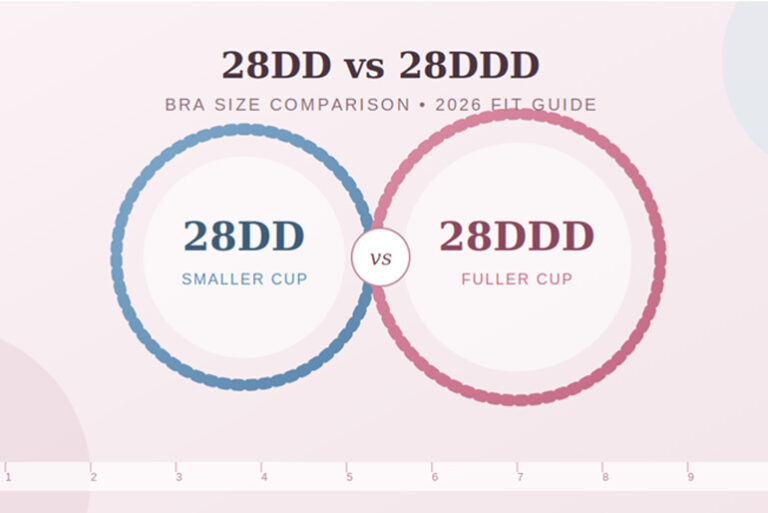
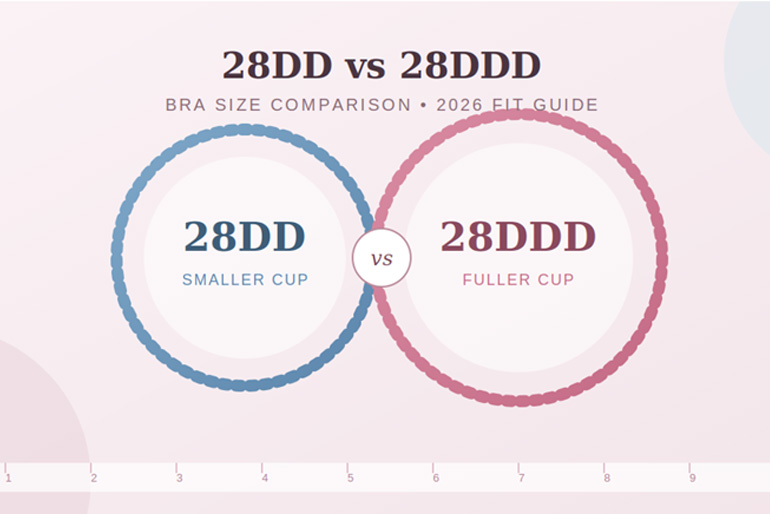
If you’ve spent any time comparing 28DD and 28DDD, you’ve probably noticed something strange: the band number never changes, but the cup letters keep climbing, and somehow every bra calculator seems to give you a different answer. That’s not you doing something wrong. It’s the bra industry using three different labeling systems at once, and none of them were built with clarity in mind.
A lot of the confusion gets blamed on “sister sizing,” so let’s clear that up first. Sister sizes are pairs of sizes that hold roughly the same cup volume, even though the numbers look different, like 28DD and 30D. 28DD and 28DDD are not sister sizes — they share the same band and move up one full cup letter, so there’s a genuine, noticeable volume difference between them. The confusion comes from somewhere else entirely.
A big culprit is the old “add 4 inches” fitting method that department stores taught for decades. That formula added 3 to 5 inches to your underbust measurement to land on a band size, which pushed most people into bands that were too big and cups that were too small. When your band runs large, your body compensates by riding up in the back and gaping in the cup — which then gets “fixed” by sizing up the cup again, and the whole system spirals into sizes that never quite feel right. Once you measure with a snug, modern method instead of the outdated add-4 approach, a lot of people find their real size sits somewhere entirely different from what they’ve been buying for years.
The fastest way to skip the guesswork is to run your numbers through a bra size calculator, which does the underbust-to-cup math for you and flags when you’re sitting right on the line between 28DD and 28DDD.
Measurement Breakdown
Because both sizes share the same band, your underbust measurement will look almost identical for either one. What separates them is the difference between your underbust and your bust at the fullest point.
28DD
- Underbust: 23–24.5 in (58–62 cm)
- Bust at fullest point: about 28–29.5 in (71–75 cm)
- Bust-to-underbust difference: approximately 5 in (12–13 cm)
28DDD
- Underbust: 23–24.5 in (58–62 cm)
- Bust at fullest point: about 29–30.5 in (74–77 cm)
- Bust-to-underbust difference: approximately 6 in (15–16 cm)
Ranges vary a little by brand, since there’s no single global standard for cup grading, but that one-inch jump between the two sizes is the real story. It’s also why two people who both measure a 28-inch band can genuinely need different cup letters — cup size was never about the band at all, it’s entirely about how much you measure over it.
This is also the reason cup letters can be misleading on their own. A D cup on a 28 band holds noticeably less volume than a D cup on a 34 band, even though the letter is identical, because cup volume scales with band size. If you want a visual sense of how these letters translate to real shape and volume, the cup size visual guide and the cup volume and projection breakdown both walk through it with side-by-side comparisons.
Quick Comparison Table: 28DD vs 28DDD
| Fit Factor | 28DD | 28DDD |
| Band snugness | Firm and stable; band does most of the support work at this size | Same firm band, but it has to anchor slightly more cup weight |
| Support level | Very good for most activities; band + cup work together | Excellent; the extra cup depth adds a touch more lift and containment |
| Cup volume | Roughly one cup-size less volume than 28DDD on the same band | Roughly one cup-size more volume than 28DD on the same band |
| Comfort for smaller ribcage | Great fit if your underbust sits at the lower end of the 28 range | Can feel tight in the band if paired with a narrower ribcage and full cup |
| Comfort for wider ribcage | May feel slightly loose in the band if you’re at the top of the 28 range | Tends to distribute weight better across a slightly broader frame |
| Common fit problems | Cup wrinkling or gaping if you actually need 28DDD | Spillage at the top or sides if you actually need 28DD |
Which Size Is Right for You?
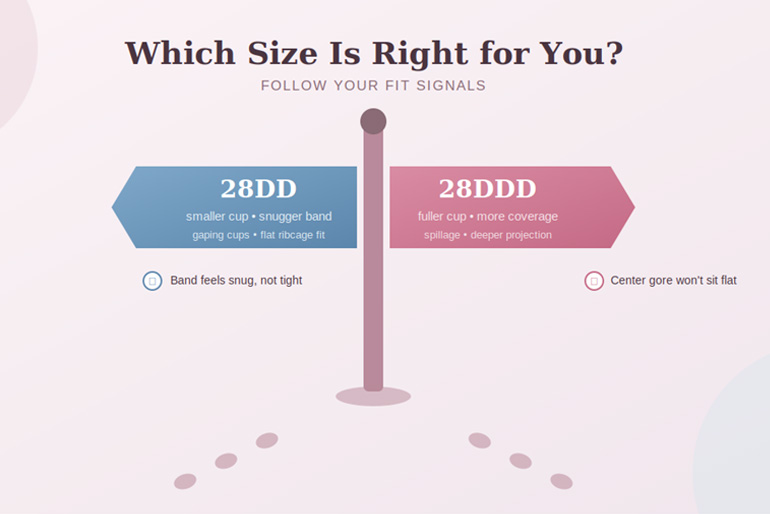
Choose 28DD if…
- Your underbust measures at the lower end of the 28-inch range and feels snug, not tight, when you exhale
- Your cups currently gape at the top or sides, even though the band feels secure
- You find yourself needing to adjust or “scoop and swoop” less than once an hour
- Underwire sits flat against your ribcage without digging in at the sides
- You’ve been wearing a larger band size, and your straps are doing most of the lifting
- Wrinkling or loose fabric shows up in the cup fabric when you look in a mirror
- You want a slightly lower-profile shape under fitted tops
Choose 28DDD if…
- Your bust measurement runs closer to the top of the range for a 28 band
- You’re currently spilling over the top or sides of your cups in 28DD
- The center gore (the piece between the cups) doesn’t sit flat against your sternum
- Underwire presses into breast tissue instead of resting on your ribcage
- You notice red marks or indentations from cups that are too shallow
- You need more coverage and containment for higher-impact activity
- You’ve sized up cups repeatedly in a larger band without solving the discomfort
The 3-Minute At-Home Fit Test
Grab a soft measuring tape and a non-padded, non-wired bra if you have one, then work through these steps. For a full walkthrough with photos, the how-to-measure guide is worth bookmarking.
- Measure your underbust. Wrap the tape directly under your bust, snug but not compressing, and read it while you exhale normally.
- Measure your bust. Wrap the tape around the fullest part of your bust, keeping it level and not pulled tight.
- Check the band. Fasten on the loosest hook and slide two fingers underneath — it should be snug, not loose, and shouldn’t ride up when you raise your arms.
- Scoop and swoop. Lean forward, scoop breast tissue into each cup from the side, then stand up straight and check for gaping or spillage.
- Check the center gore. It should lie flat against your sternum; if it’s floating away from your body, the cup is too small.
- Test the straps. They should rest on your shoulders without digging in — if you’re relying on tight straps for lift, the band is doing too little work.
- Move around. Walk, raise your arms, and bend forward. A well-fitted bra stays in place through all of it without you touching it.
Common Fit Mistakes
- Tightening the straps to compensate for a band that’s actually too loose, instead of sizing down the band
Wearing a band that rides up in the back and assuming it just needs a firmer hook, when it usually means the band size itself is too big
- Assuming any gaping automatically means the cup is too big, when a too-large band can cause the same gaping by pulling the whole bra forward
- Trusting the cup letter to mean the same thing across every brand, when cup grading and shape vary significantly by manufacturer
- Starting on the tightest hook instead of the loosest, which leaves no room to tighten the band as it stretches with wear
- Ignoring the center gore entirely, even though it’s one of the clearest signals that a cup is too small or too large
Sister Sizes to Try
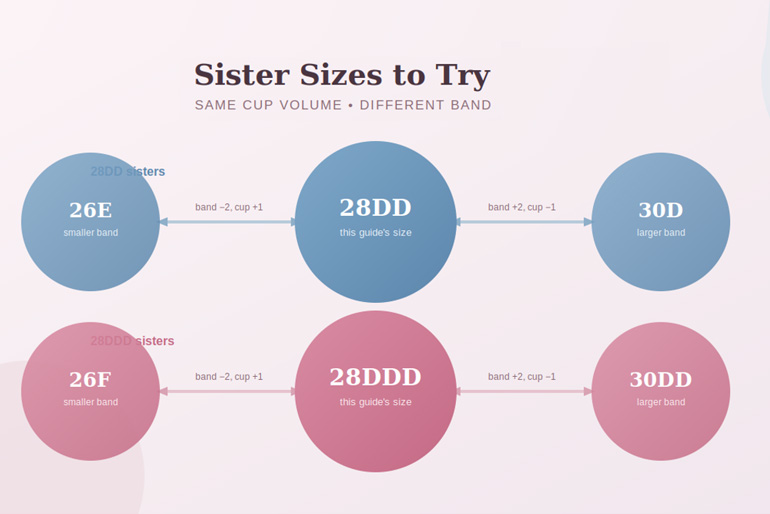
If neither 28DD nor 28DDD feels quite right, sister sizes give you the same approximate cup volume in a different band. Since brands don’t always carry every size, this is often the difference between finding nothing and finding something that fits. Run any of these through a sister size bra calculator before you buy, since the shift also changes the overall shape slightly.
If 28DD is close but not quite right, try:
- 30D — same cup volume, larger band, looser overall fit
- 26E (or 26DDD, depending on the brand’s labeling) — same cup volume, smaller band, snugger overall fit
If 28DDD is close but not quite right, try:
- 30DD — same cup volume, larger band, looser overall fit
- 26F (or 26DDDD, depending on the brand) — same cup volume, smaller band, snugger overall fit
For a broader view of how these sizes relate to sizes outside this pair, the sister size chart and breast size comparison hub both break down the full range.
Frequently Asked Questions
Is 28DDD bigger than 28DD?
Yes. They share the same band, but 28DDD holds roughly one cup size more volume than 28DD.
Do 28DD and 28DDD fit the same band?
The band number is the same, but band feel can differ slightly, since a fuller cup places a bit more pull on the band even at an identical size.
Why do I measure differently in every brand?
Cup grading isn’t standardized across manufacturers, so a 28DD in one brand can fit closer to a 28DDD in another. This is normal and expected, not a sign you measured incorrectly.
What if I’m between 28DD and 28DDD?
Try both in the same style before deciding, and lean toward whichever one leaves the center gore flat against your sternum. An AI-powered smart fit calculator can also weigh your exact measurements against brand-specific sizing data to narrow it down.
Should I size up the band or the cup if nothing fits right?
Start with the band, since band snugness supports about 80% of a bra’s job. If band comfort is right but you’re still gaping or spilling, that points to a cup adjustment instead. The bra fit problems guide covers troubleshooting for specific symptoms in more depth.
Final Thoughts
28DD and 28DDD sit right next to each other on paper, but on your body, they can feel like two completely different bras. The band number staying the same is exactly what makes people assume the sizes are interchangeable, when really, the entire difference comes down to how much you measure over that band. Trust your own fit signals over the label — a flat center gore, a band that doesn’t ride up, and cups that neither gape nor spill will tell you more than any size chart. And if you’re still on the fence, running your exact numbers through a calculator and comparing both sizes side by side in the same style is the fastest way to stop guessing.
Disclaimer: Measurements and size ranges in this guide are general estimates based on common bra sizing standards and can vary between brands, cuts, and manufacturers. This article is intended for general fit guidance only and isn’t a substitute for a professional fitting if you have specific comfort, medical, or post-surgical fit concerns.