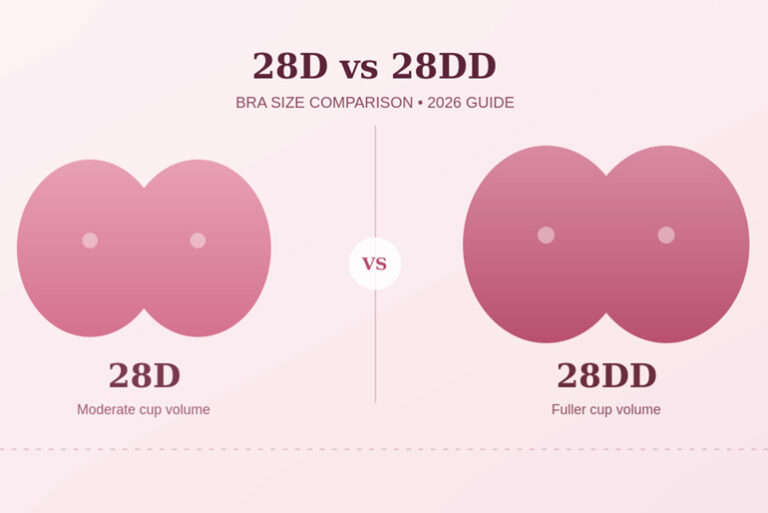
If you’ve been standing in a fitting room (or scrolling a size chart at midnight) trying to figure out whether you’re a 28D or a 28DD, you are not alone — and you are not bad at math. These two sizes sit right next to each other on the chart; they share the exact same band, and the difference between them is genuinely small. But small doesn’t mean unimportant. Getting it right is the difference between a bra that disappears under your shirt all day and one you’re adjusting every twenty minutes.
This guide breaks down exactly what separates a 28D from a 28DD, why the confusion happens in the first place, and how to figure out — with real measurements, not guesswork — which one belongs in your drawer.
Why These Sizes Are Confusing
Here’s the thing nobody tells you at the department store: cup letters are not fixed sizes. A D cup on a 28 band is not the same volume as a D cup on a 36 band. Cup volume is relative to band size, which means the same amount of breast tissue can be labeled a D in one band and a DD (or C) in another. This is the whole idea behind sister sizing — sizes that sit on a diagonal line across the chart and share the same cup volume even though the numbers and letters look completely different.
So a 28D and a 30C, for example, hold roughly the same volume of tissue, just distributed across a slightly different band circumference. That’s genuinely useful to know if your usual size is out of stock, or if a brand runs its bands narrow or wide.
Most of the confusion, though, traces back to an outdated fitting method that’s still floating around in some stores and old size charts: the “+4 inches” rule, where you measure your underbust and simply add four inches to estimate your band size. This method was designed decades ago around a completely different set of bra construction standards, and it tends to push people into bands that are too big and cups that are too small — which is exactly how someone who should be a 28DD ends up wearing a 34C for years without knowing why nothing ever quite fits right.
If you’d rather skip the mental math entirely, our bra size calculator does the sister-size and band math for you in about ten seconds.
Measurement Breakdown
Numbers make this a lot less abstract. Here’s what the underbust and bust ranges actually look like for each size:
| Size | Underbust (in) | Underbust (cm) | Bust (in) | Bust (cm) |
| 28D | 23–24″ | 58–61 cm | 27–28″ | 69–71 cm |
| 28DD | 23–24″ | 58–61 cm | 28–29″ | 71–74 cm |
Notice that the underbust range is identical for both sizes — that’s expected, since the band number (28) is the same in both. What changes is the bust measurement, and therefore the difference between bust and underbust, which is what determines the cup letter.
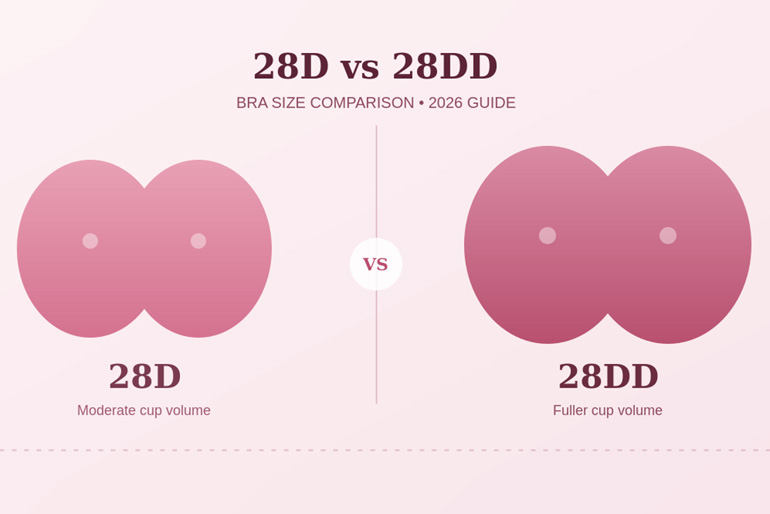
This is also why cup volume can feel deceptively similar between the two: a 28D and a 28DD are only about one inch of bust measurement apart, which typically translates to roughly 50cc of additional cup volume — noticeable, but not dramatic. It’s enough to matter for comfort and shape, but not enough to send you searching for a completely different band size.
For a deeper look at how cup volume is calculated and how it relates to breast shape, see our cup volume guide and projection and shape guide.
Quick Comparison Table
| Feature | 28D | 28DD |
| Band snugness | Firm, supportive fit on a 23–24″ ribcage | Same firm band fit; band does the same job either way |
| Support level | Very good — moderate cup, band carries most weight | Slightly more structured support needed for the added cup volume |
| Cup volume | Roughly 400–450cc per cup (approximate) | Roughly 450–500cc per cup — one “step” fuller than a D |
| Comfort for smaller ribcage | Excellent — this is the intended fit range | Excellent, same band range, just more cup fabric on top |
| Comfort for wider ribcage | May feel tight if underbust runs closer to 25″ | Same band concern; cup will still gape if band is sized up instead |
| Common fit problems | Cup gapping at the top if actually a DD | Quad-boob or spillage if actually only a D; band riding up if too loose |
Which Size Is Right For You?
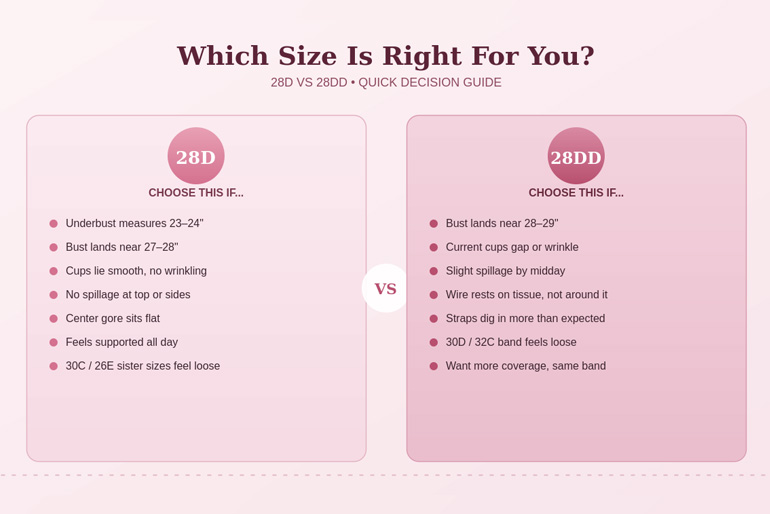
Choose 28D if…
- Your underbust measures a firm 23–24 inches with the tape snug but not digging in
- Your bust measurement lands closer to 27–28 inches
- Your current bra’s cups lie smooth with no wrinkling or empty space at the top
- You don’t notice any spillage at the top, sides, or under the arm
- The center gore sits flat against your breastbone without lifting away
- You feel supported without needing to adjust throughout the day
- A 30C or 26E (its sister sizes) also feels close, but the 28 band feels the most secure of the three
Choose 28DD if…
- Your bust measurement is closer to 28–29 inches over the same 23–24 inch underbust
- You’re currently in a 28D, but seeing cup fabric wrinkle or gap at the top, like there’s empty space
- You notice slight spillage at the top edge of the cup by midday
- Underwire sits on breast tissue rather than fully around it
- Straps dig in more than expected because the cup isn’t carrying its fair share of the weight
- You’ve been wearing a 30D or 32C, and the band feels loose when you hook it on the middle set
- You want a little more coverage and shaping without sizing the band up
3-Minute At-Home Fit Test
- Measure your underbust. Wrap a soft tape snugly around your ribcage, directly under your bust, keeping it parallel to the floor.
- Measure your bust. Wrap the tape around the fullest part of your bust, without compressing tissue or pulling the tape tight.
- Check the band. Put the bra on and fasten it on the loosest hook. The band should sit level and snug — you should be able to fit two fingers under it, no more.
- Scoop and swoop. Lean forward, let the cups catch all your breast tissue, then scoop any tissue from the sides or underarm into the cup before standing up.
- Check the center gore. It should lie flat against your breastbone with no gap or lift — if it’s floating, the cup is too small.
- Test the straps. Slide two fingers under each strap; they shouldn’t dig in or leave deep marks, and the band (not the straps) should be doing most of the support work.
- Move around. Raise your arms, walk a few steps, and bend slightly forward. A well-fitted bra stays in place with no riding up, gaping, or shifting.
Common Fit Mistakes
- Tightening the straps instead of sizing down the band when support feels off
- Wearing a band that’s already riding up in the back, which pushes all the support onto the straps
- Assuming cup gaping always means the cup is too big, when it often means the band is too loose
- Forgetting that sizing is not standardized — a 28D in one brand can fit like a 28DD or even a 28C in another
- Starting out on the loosest hook instead of the tightest, leaving no room to tighten the band as it stretches with wear
- Ignoring the center gore — if it doesn’t sit flat against your sternum, the cup size needs adjusting before anything else
If your band keeps riding up no matter what you try, our bra band rides up troubleshooting guide walks through the most likely causes.
Sister Sizes to Try
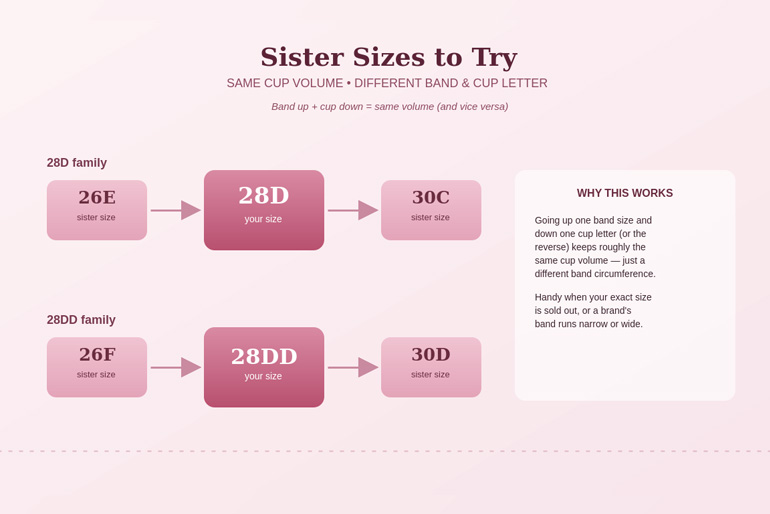
If neither 28D nor 28DD is available in the style you want, these sister sizes carry a comparable cup volume:
- 28D sister sizes: 30C and 26E
- 28DD sister sizes: 30D and 26F
Going up a band size always pairs with going down a cup size (and vice versa) to keep the same approximate volume — this is the fastest workaround when your exact size is sold out.
Use our sister size chart or the sister size bra calculator to find your full range of equivalent sizes in seconds.
Frequently Asked Questions
Is a 28DD bigger than a 28D?
Yes, slightly. Both share the same 28-inch band, but the DD cup holds more volume — roughly one cup size more than the D, which usually translates to about an inch more bust measurement.
Do 28D and 28DD use the same band?
Yes. The band number stays identical across cup letters within the same size family; only the cup volume changes.
Why do I measure as a 28D in one brand and a 28DD in another?
Cup and band construction isn’t standardized across manufacturers. Wire shape, cup seaming, and fabric stretch all shift how a given size fits, which is why it’s normal to size up or down a cup letter between brands.
What if my band measurement falls between two sizes?
Round to the nearest even number and try both if possible. A snug-but-comfortable fit on the loosest hook is the better sign than the number itself.
Can I wear a 28DD if I’ve always worn a 30D?
Often, yes — they’re sister sizes with similar cup volume. The 28DD will have a snugger band and a slightly deeper cup than the 30D, so try both if you can.
Should I size up if the cups gap slightly at the top?
Not necessarily — try sizing down a cup letter first (28D instead of 28DD) before changing the band, since gore fit and band snugness usually matter more than the gap alone.
Final Thoughts
The gap between a 28D and a 28DD is small on paper but can feel meaningfully different against your body — one extra inch of bust measurement is often the line between a bra that fits like it was made for you and one that’s just fine. The good news is that the fix rarely requires an entirely new size family; it usually just means adjusting one cup letter up or down while keeping your band exactly where it is.
If you’re still unsure after measuring at home, trust the fit test over the label. Scoop, swoop, check the gore, and watch how the bra behaves after twenty minutes of normal movement — that tells you more than any chart.
For more comparisons like this one, browse our full breast size comparison hub, or try the AI smart fit calculator for a personalized recommendation based on your exact measurements.
Disclaimer: This article is for general informational purposes only and reflects typical sizing conventions, which vary by brand and country. It is not a substitute for a professional fitting. Measurements are approximate and intended as a starting point, not a guarantee of fit.