
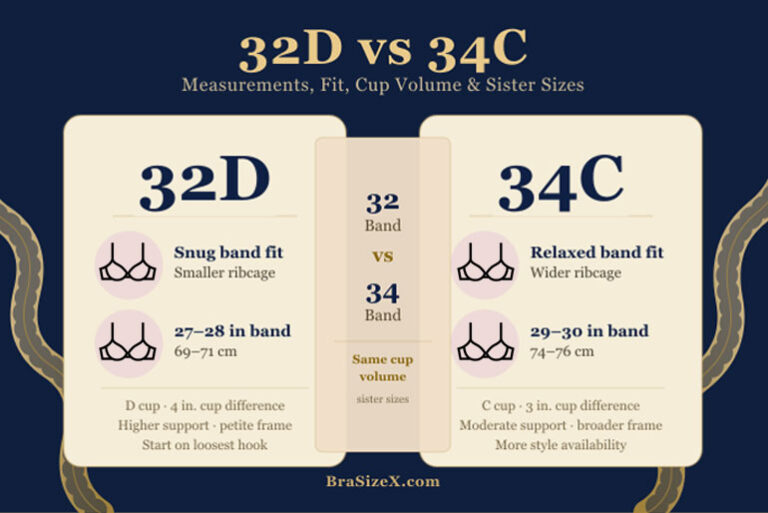
These two sizes hold the same volume of breast tissue — but they fit completely differently depending on your ribcage. Here’s how to tell which one actually belongs on your body.

Why These Two Sizes Confuse So Many People
At first glance, 32D and 34C look like completely different bras. One has a smaller band and a bigger-sounding cup. The other has a larger band and what most people assume is a smaller cup. So it’s natural to think: “a 34C must be bigger than a 32D, right?”
Wrong — and that exact assumption is where most bra shopping goes off the rails.
32D and 34C are sister sizes. That’s a term used in the bra industry to describe sizes that share the same cup volume despite having different band measurements and different cup letters. The cup letter isn’t an absolute measurement — it’s a ratio. A D cup on a 32 band is not the same physical size as a D cup on a 36 band. The cup volume is calculated as the difference between your bust measurement and your underbust measurement, so as the band number goes up, the cup letter goes down to keep that volume consistent.
This is why a 32D and a 34C hold exactly the same amount of breast tissue. The band is different. The cup letter is different. The fit experience is very different. But the cup volume is identical.
The +4 method is largely to blame. For decades, department stores taught fitters to add 4 inches to your underbust measurement before selecting a band size. So if your underbust was 28 inches, you’d be placed in a 32 band — sometimes even a 34. This produced loose, unsupportive bands and tiny-sounding cup letters, leaving a lot of women thinking they were a 34B or 34C when their true size was actually a 30D or 32C. The bra size calculator uses your actual measurements, not the +4 formula.
The result of all this confusion is that millions of women are wearing a 34C when they should be in a 32D, or vice versa — and wondering why their bras never quite feel right. Let’s break down exactly what separates these two sizes.
Measurement Breakdown: What the Numbers Actually Mean
Every bra size is defined by two measurements: your underbust (the circumference of your ribcage directly under your breasts) and your bust (the fullest part of your chest). The difference between those two numbers gives you your cup size.
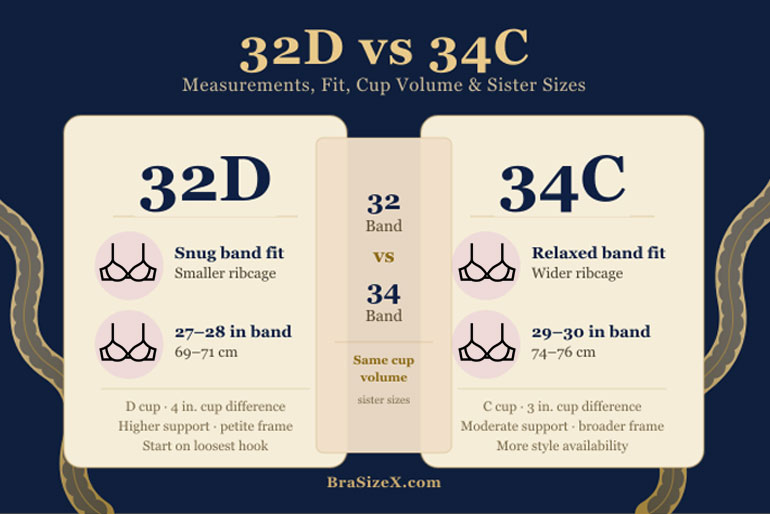
32D
| Underbust | 27–28 in (69–71 cm) |
| Bust | 31–32 in (79–81 cm) |
| Cup difference | 4 inches = D cup |
| Band feel | Firm, close-fitting |
| Band length | Shorter, less stretch |
34C
| Underbust | 29–30 in (74–76 cm) |
| Bust | 33–34 in (84–86 cm) |
| Cup difference | 3 inches = C cup |
| Band feel | Relaxed, roomier |
| Band length | Longer, more stretch |
Notice that the cup difference is 4 inches for 32D and 3 inches for 34C — yet the cup volume is the same. This happens because a 34C bust sits 3 inches above a larger base (the 34-inch band), while a 32D bust sits 4 inches above a smaller base. The math balances out. Both shapes accommodate the same breast tissue volume.
This is why going up a band size and down a cup letter — or down a band and up a cup — keeps your overall cup volume stable. It’s the core principle behind sister sizing, and it’s explained in detail in our cup size visuals guide and projection guide.
Quick Comparison: 32D vs 34C at a Glance
| Factor | 32D | 34C |
|---|---|---|
| Band Snugness | Firm and close to the body — intended for underbust of 27–28 in | Relaxed fit — designed for underbust of 29–30 in |
| Support Level | Higher — the snug band carries most of the breast weight | Moderate — adequate for smaller frames but can ride up on narrow ribcages |
| Cup Volume | Identical — same breast tissue volume in both sizes | |
| Best for Smaller Ribcage | ✓ Designed for this — band won’t gape or shift | ✗ Band will be too loose, reducing support |
| Best for Wider Ribcage | ✗ Band will feel restrictive or may not close comfortably | ✓ Designed for this — band won’t dig in or feel tight |
| Common Fit Problems | Can feel too tight if worn on the wrong ribcage; some styles hard to find in petite range | Band rides up, straps slip, underwires float off the chest wall on narrower ribcages |
The single most important takeaway: cup volume is not the differentiator here. Band fit is. If your ribcage doesn’t match the band number, no amount of cup letter adjustment will make the bra work.
Which Size Is Right for You?
Use your underbust measurement as the starting point — not your cup feeling, not what you’ve always worn, and definitely not what a fitting room assistant told you ten years ago. Grab a soft tape measure and check your actual number. Then use the lists below.
Choose 32D if…
- Your underbust measures 27–28 inches (68–71 cm)
- Your current 34C band rides up your back during the day
- You find yourself tightening the bra straps to compensate for a loose band
- The underwire drifts away from your chest wall or floats on the sternum
- You can pull the back band more than 1 inch away from your body
- You have a narrow or petite frame and feel “swallowed” by standard sizing
- You’re already wearing your 34C on the tightest hook and it still feels loose
Choose 34C if…
- Your underbust measures 29–30 inches (74–76 cm)
- Your current 32D digs into your ribcage or leaves red marks at the end of the day
- You struggle to fasten the band comfortably on the loosest hook
- The band feels restrictive when you breathe deeply or lean forward
- You have a broader back or slightly athletic build
- You find 32-band bras in wider availability of styles you like
- Side panels feel like they’re pulling your breast tissue backward uncomfortably
Still not sure? Our how to measure guide walks you through taking accurate measurements at home, and the sister size chart shows your full range of equivalent options across brands.
The 3-Minute At-Home Fit Test
Before you write off either size, put on the bra you’re testing and work through these seven steps. They take about three minutes and will tell you more than any calculator.
Measure your underbust (bare skin, exhale)
Wrap the tape snugly around your ribcage directly under your breasts. Exhale normally, then note the measurement. This is your band baseline — round to the nearest even number. If it’s 28 inches, a 28 or 30 band is your true fit range; 32 starts to stretch it.
Measure your bust (leaning forward, loose)
Lean forward at 90 degrees so your breasts hang naturally, then measure around the fullest point. This forward lean captures your full breast volume — standing upright often undercounts. Subtract your underbust from this number to get your cup size.
Check the band
Put the bra on the loosest hook (as it will stretch over time, you want room to tighten). The band should sit level all the way around — parallel to the floor front and back. Try sliding two fingers under the back band. Snug but possible = good. Easy hand-width gap = too loose.
Scoop and swoop
Lean forward, reach into each cup, and scoop all breast tissue — including any tissue from your armpits and side — forward into the cup. Stand back up. If the cup overflows or the underwire is sitting on breast tissue rather than chest wall, you need a larger cup. If the cup gapes, you need a smaller one.
Check the center gore
The center front of the bra (the piece between the cups) should lie flat against your sternum. If it’s floating, tenting, or refusing to touch your chest, the cups are too small — even if the band feels fine. This is one of the most overlooked fit signals.
Adjust the straps — but barely
Straps should rest on your shoulders without digging in, and you should be able to slide two fingers under them. They are not meant to be load-bearing — a well-fitted band does 80–90% of the support work. If you’re yanking the straps tight to feel lifted, the band is too loose.
Move around
Raise your arms overhead, twist side to side, and hug yourself. Nothing should shift, ride up, dig in, or pop open. The bra should move with you. If the band creeps up toward your shoulder blades when you lift your arms, that’s a band-too-loose situation — a strong signal to try a sister size with a smaller band.
Common Fit Mistakes That Affect Both Sizes
- Tightening straps to solve a support problem: Straps can only pull up — they can’t anchor the bra to your body. If you’re constantly yanking them up or your shoulders are aching at the end of the day, the real issue is almost always a band that’s too loose. Try the next sister size down in band before adjusting a single strap.
- Ignoring a riding-up band: A band that rides up your back is the number one sign it’s too large. It means the band isn’t anchored to your ribcage — so it migrates upward. For both 32D and 34C wearers, this is worth diagnosing immediately rather than tolerating. See our full bra band rides up guide.
- Assuming cup gaping means you need a smaller cup: Cup gaping is often a band problem. If the band is too loose, the whole bra shifts forward, and the cups lose contact with your chest. Before sizing down in a cup, try the same cup in a smaller band — your sister size — and see if the gaping disappears.
- Trusting size across brands without adjustment: A 34C in one brand is not the same physical bra as a 34C in another. Cup depth, wire width, and band elasticity vary significantly. If you switch brands and something feels off, treat it as a new fitting process rather than assuming the size is wrong.
- Starting on the tightest hook: New bras should fit on the loosest hook. As the elastic stretches over weeks of wear, you move to tighter hooks to compensate. If you need the tightest hook on a brand-new bra, it’s already too big. This is one of the fastest ways to end up in a 34C when you should be in a 32D.
- Ignoring the center gore: Most women check the band and the cups, but forget the gore — that small piece of fabric or hardware between the cups. If it doesn’t lie flat against your sternum, the cups aren’t sitting correctly on your chest, which affects both comfort and breast shape. A floating gore usually signals under-cupping, even if everything else feels okay. Check out our bra fit problems guide for a full diagnostic.
Sister Sizes to Try Next
If neither 32D nor 34C feels quite right, sister sizing lets you adjust band and cup together without changing your overall fit. Here’s the full chain for this cup volume:
28F → 30E → 32D → 34C → 36B → 38A
Moving left along this chain means a tighter band and a larger cup letter. Moving right means a looser band and a smaller cup letter. The cup volume stays the same throughout. This is especially useful when your brand doesn’t carry your true size — a 30E can wear a 32D, and a 34C can wear a 36B, with minor adjustments.
Use the full sister size chart to explore this chain across all sizes, or try the sister size bra calculator if you want instant results based on your current size.
Keep in mind that sister sizing is a shopping workaround, not a permanent fix. If you consistently need to go two or three steps down the chain to get a comfortable band, it may be time to accept a different “true” size rather than continuing to compensate.
Frequently Asked Questions
Is 32D the same as 34C?
They are sister sizes — meaning the cup volume is mathematically the same. However, a 32D has a tighter, shorter band while a 34C has a looser, longer band. They will not fit the same person equally well unless her ribcage happens to sit right between both measurements.
Which is bigger, 32D or 34C?
Neither is “bigger” in terms of cup volume — they hold the same amount of breast tissue. The difference is the band: 34C wraps around a larger ribcage, while 32D wraps around a smaller one. The cup letter changes to keep the breast-to-band ratio consistent.
Can I wear a 34C if I’m a 32D?
You might be able to, especially on a snug hook setting, but it depends on your actual underbust measurement. If your underbust measures 27–28 inches, 32D is the better fit. If it measures 29–30 inches, 34C may work. Going up a band size typically means the bra sits looser and rides up more easily.
Why does my bra say 34C but feel too loose in the band?
This is very common and often traces back to the outdated +4 fitting method, which added 4 inches to your underbust measurement before selecting a band. If your true underbust is around 28 inches, many older fitting systems would place you in a 32 band — but the +4 rule would push you into a 34, making the band too loose and compensating with a smaller cup letter.
What are the sister sizes for 32D and 34C?
The sister size chain for this cup volume runs: 28F → 30E → 32D → 34C → 36B → 38A. Going up one band size means going down one cup letter to maintain the same cup volume. Going down one band size means going up one cup letter.
How do I know if my bra band is too loose?
If you can pull the back band more than one inch away from your body, or if it rides up toward your shoulder blades during the day, the band is too loose. A properly fitting band should feel snug enough that you can slip two fingers underneath — not a whole hand.
Final Thoughts
The 32D vs 34C comparison really comes down to one thing: your ribcage, not your cup. Both sizes hold the same volume of breast tissue, but they’re built for different bodies. A 32D is made for a narrower ribcage where a firm band will feel secure and supportive. A 34C is built for a slightly wider frame where a longer band sits comfortably without digging in.
If you’ve been wearing one size and it’s never felt quite right — band riding up, straps slipping, cups gaping at the top, or underwires poking your armpit — it’s worth trying the other. Sometimes a single sister size swap resolves years of low-grade bra frustration.
Take your measurements, do the fit test, and go from there. And if you’re still unsure, the bra size calculator and AI smart fit calculator can help you narrow it down quickly.
Related Comparisons
Looking at nearby sizes? These comparison pages cover similar sister size questions:
- 32C vs 34B
- 34C vs 36B
- 32D vs 34D
- 30E vs 32D
- 32D vs 32C
Disclaimer: The size ranges and measurement guidelines on this page are general reference information based on standard industry sizing conventions. Actual fit varies by brand, style, and individual body shape. BraSizeX is a celebrity bra size reference and informational resource — we do not sell bras or provide professional fitting services. Always try bras on before purchasing when possible, and consult a professional bra fitter if you have specific fit concerns.