A few years back, my sister dragged me into a lingerie store because she was convinced she’d been wearing the wrong bra size “her entire adult life.” She had — she’d been squeezing into a 34B since high school when she actually needed a 32D. The fitter took one look, grabbed three styles, and came back with bras that fit perfectly. My sister literally teared up. She said it felt like she’d been wearing the wrong shoes for a decade.
That moment stuck with me. It made me realize how little most of us actually know about bra sizing — including what’s considered “average,” why it varies so much across the world, and why that number on the tag is so often wrong for the person wearing it.
So I went deep on this. Read studies, looked at actual retail data from major lingerie brands, talked to a couple of fitters, and put together everything you actually need to know.
First, Let’s Kill the “34B Is Average” Myth
For years — and I mean decades — the fashion and lingerie industry repeated this claim: the average American woman wears a 34B. It was printed in magazines, echoed by brands, and accepted as fact.
It’s not really accurate anymore. And honestly, it probably never was.
More recent retail and survey data suggest the real average in the US is closer to a 34DD or 36C, depending on the source. Lingerie brand ThirdLove, which has collected fitting data from millions of customers, found that the most commonly purchased cup size among their shoppers was a DD, not a B.
Part of why the old myth persisted is that bra manufacturers had a financial incentive to produce more of the easier-to-make, smaller cup sizes. And for a long time, women just wore whatever fit “close enough” because options were limited.
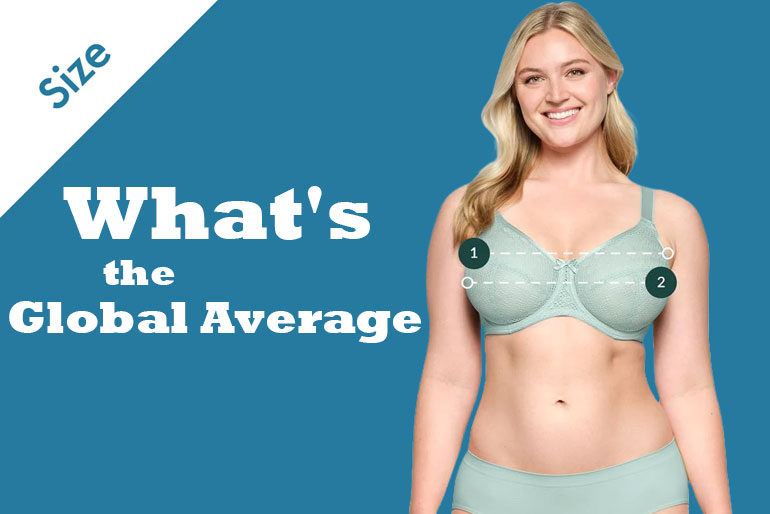
So What’s the Global Average?
This gets genuinely interesting — and a little surprising.
Different countries have noticeably different averages, shaped by genetics, diet, body composition, and even how sizing is measured locally (European sizing, UK sizing, and US sizing all work slightly differently, which complicates direct comparisons).
Here’s a rough breakdown based on research studies, lingerie industry data, and retail surveys:
🇺🇸 United States
Average: 34DD
Americans have one of the larger average cup sizes globally. This is influenced by higher average BMI across the population, since breast size and body weight are correlated — though not exclusively so. US lingerie retailers like Victoria’s Secret, ThirdLove, and Soma all report that D and DD cups are their most popular categories.
🇬🇧 United Kingdom
Average: 36D
The UK has historically reported larger average cup sizes than most of Europe, and a 2018 report from lingerie brand Triumph found that British women average a 36D. Interestingly, UK women also tend to be more likely to get professionally fitted — bra fitting is almost a cultural institution at department stores like John Lewis and Marks & Spencer.
🇫🇷 France
Average: 90B (roughly 38B in US sizing)
France skews smaller in cup size but larger in band size compared to the US, partly due to differences in how French women are measured and how their bodies are proportioned on average. French lingerie culture prioritizes fit and delicacy over volume.
🇩🇪 Germany
Average: 80C or 85C (roughly 36C in US sizing)
Germany sits in the middle of the European range. German lingerie brands like Triumph and Schiesser have reported C cups as their top sellers, with a growing market for larger cups as measurement awareness increases.
🇯🇵 Japan
Average: 75B or 70B (roughly 34B or 32B in US sizing)
Japan has one of the smallest average cup sizes globally. Japanese women tend to have smaller frames overall, and the lingerie industry there caters heavily to A and B cups. Japanese bra sizing is also extremely precise — brands there offer a wider range of small band/small cup combinations than Western brands typically do.
🇦🇺 Australia
Average: 14C (roughly 36C in US sizing)
Australia sits close to the UK and US in terms of average size, with C and D cups being the most commonly sold. Australian lingerie brand Berlei has reported increasing demand for DD+ sizes over the past decade.
🇮🇳 India
Average: 34B
India has a growing lingerie market, and survey data from brands like Zivame suggests the 34B remains the most commonly purchased size — though this may reflect availability as much as actual average size, since larger cup sizes have historically been harder to source in India.
🇧🇷 Brazil
Average: 44B (roughly 36B in US sizing)
Brazil has a larger average band size but a smaller average cup size, reflecting overall body proportions. The Brazilian lingerie market is one of the largest in the world, and styles tend to emphasize coverage and support.
Scandinavia (Norway, Sweden, Denmark)
Average: 75D or 80C (roughly 34D or 36C in US sizing)
Scandinavian women tend toward larger cup sizes relative to their band size. Swedish brand Lindex has reported a D cup as a top seller, and Norwegian surveys have found similar patterns.
Why These Numbers Are Tricky to Trust Completely
I want to be upfront about something: this data is messy.
Most “average bra size by country” statistics come from lingerie brand sales data, not actual physical measurements of a random population sample. That means the numbers reflect what women buy, not necessarily what they should be wearing.
And here’s the uncomfortable truth — a huge percentage of women are wearing the wrong size right now. Studies estimate that somewhere between 70–80% of women are in an incorrectly fitting bra, usually with a band that’s too big and cups that are too small.
So when a brand reports that 34B is the average in their sales data, it might mean that 34B is the most commonly stocked and easiest-to-find size — not that it actually fits the most women.
How Bra Sizing Actually Works (And Why It Confuses Everyone)
Here’s the part that genuinely surprised me when I first learned it.
The band size (the number — 32, 34, 36, etc.) is your underbust measurement in inches, usually with an inch or two of ease added.
The cup size (A, B, C, D, etc.) isn’t an absolute measurement — it’s a difference between your bust measurement and your band measurement.
So a 32D and a 38D are completely different cups in terms of actual volume. A 32D has much less breast tissue in the cup than a 38D does, even though they’re both “D cups.” This concept is called sister sizing, and it’s why a woman who wears a 32D could theoretically fit into a 34C — same volume, different band.
This is why “average cup size” data is so slippery. The letter means nothing without the number.
How to Find Your Actual Size (Without Guessing)
Here’s what actually works, based on conversations with professional fitters and my own experience:
Step 1: Measure your underbust. Wrap a soft tape measure snugly around your ribcage, just under your breasts. That number (in inches) is your approximate band size. If it’s odd, round up.
Step 2: Measure your bust. Measure around the fullest part of your chest, keeping the tape parallel to the floor.
Step 3: Find the difference. Subtract your band measurement from your bust measurement. Each inch of difference corresponds roughly to a cup size: 1 inch = A, 2 inches = B, 3 inches = C, 4 inches = D, 5 inches = DD, and so on.
Step 4: Try it on and actually assess it. This is the part most guides skip. When you put on a bra:
- The band should be snug, but you should be able to slide two fingers underneath it
- The center gore (the part between the cups) should lie flat against your sternum
- No spillage over the top or sides of the cups
- Straps shouldn’t be doing all the work — the band does about 80% of the support
Step 5: Don’t stop at one size. Try the size you calculated, but also try the sister sizes (one band up + one cup down, or one band down + one cup up). Fit varies a lot between brands and styles.
If you want to skip the math, apps like ThirdLove’s Fitting Room quiz, True&Co’s fit quiz, and Rigby & Peller’s virtual fitting do a surprisingly decent job of getting you in the ballpark.
For the most accurate result, though? Go to a physical fitting. Nordstrom, Marks & Spencer, and most independent lingerie boutiques offer this free. Book it. My sister’s life changed.
Common Mistakes That Lead to the Wrong Size
Measuring over a padded bra. Always measure over nothing or a very thin, unpadded bralette.
Going by what you’ve always worn. Your size changes. Weight fluctuations, hormonal shifts, pregnancy, and age — all of these affect breast tissue. Recheck every couple of years at a minimum.
Assuming a letter equals a size. As explained above, a D cup in a 32 band is completely different from a D cup in a 38 band. Stop thinking of letters as absolute measurements.
Ignoring the band fit. Most women wear their bands too loosely. If the bra rides up in the back, the band is too big.
Only trying one style. A balconette fits differently from a full-cup bra, even in the same size from the same brand.
One More Thing Worth Knowing
Breast size varies enormously, and none of it is “better” or “worse.” The lingerie industry has, for a long time, made women feel like they needed to conform to some idealized size — and that’s just not reality.
The goal isn’t to hit some country average. The goal is to wear something that actually fits your body, supports you properly, and feels comfortable. Whether that’s a 30A or a 44G, the right bra exists — it just takes a little more hunting at the extremes of the size spectrum.
The good news is that extended sizing has improved dramatically. Brands like Elomi, Panache, ASOS Curve, Curvy Kate, and Bravissimo have made it much more realistic to find great options outside the traditional 32–38 / A–D range.
The average bra size by country is a fascinating data point, but take it as context rather than a target. What matters is what fits you — and now you have what you need to figure that out.